

/prod01/wlvacuk/media/departments/digital-content-and-communications/images-2026/Claire-Macdonald-graduate---courtyard-2-wolf-resized.jpg)
/prod01/wlvacuk/media/departments/digital-content-and-communications/submitted-news-images/nss2026_800x400-1.jpg)
/prod01/wlvacuk/media/departments/digital-content-and-communications/images-2024-25/240404-Digital-Humanities-Training-Resized.jpg)
/prod01/wlvacuk/media/departments/digital-content-and-communications/submitted-news-images/Indian-weightlifting-team.JPG)
/prod01/wlvacuk/media/departments/digital-content-and-communications/submitted-news-images/Women-in-Engineering-Day.JPG)
/prod01/wlvacuk/media/departments/digital-content-and-communications/images-18-19/220207-Midwives-Resized.jpg)
The Construction Futures Research Centre (CFRC) has been pioneering research in the field of sustainable construction, shaping and informing decisions, policy and practice, and enhancing societal impact globally. Interdisciplinary research is intrinsic to CFRC and it integrates three core pillars: people, processes and technology to address challenges pertinent to construction industry. Centre is dedicated to being “an innovative and agile centre of excellence in green and sustainable construction; applying an industry facing people-centric approach with real impact at local, national and international communities”. This vision underpins the ethos of United Nations (UN) Sustainable Development Goal 11 “Make cities inclusive, safe, resilient and sustainable”.
- First-tier beneficiaries – direct project investors and end users
- Second-tier beneficiaries – supply chain services underpinning projects (such as design, procurement, manufacturing, servitisation etc.)
- Third-tier beneficiaries – wider economy and society (including wider societal impact stemming from publicly-funded research social, cultural, environmental, economic measures).
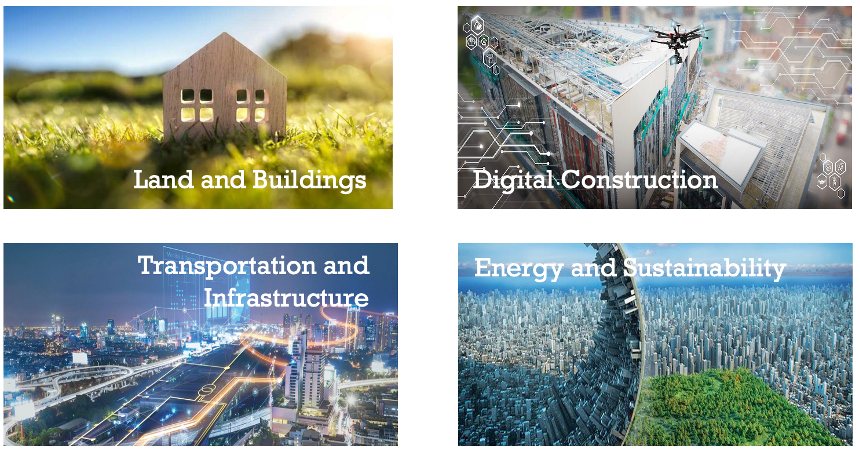
CFRC foster and accelerates cross-cutting research through four thematic clusters.
Research groups
CFRC foster and accelerates cross-cutting research through four thematic clusters.
This thematic group promotes automation, process improvements and resource efficiency in construction projects. It consolidates digital research through several core areas, all of which support industry demand for rigorous and relevant research: Use of advanced tools and technologies (handheld, wearable etc) to scan buildings and create 3D spatial mapping/ digital twins; promote techniques (discrete event simulation, BIM, AI, generative design etc) to simulate construction processes right through design, manufacture, installation and operation of built assets; Supporting companies, construction industry and its supply chain to improve the efficiency (resources), productivity and reduce waste; promotion and adaptation of modern methods of construction (MMC).