
School of Health and Wellbeing

BSc (Hons) Health and Social Care

BSc (Hons) Part-time 6 years, Full-time 3 years

Make a difference where it matters most. Develop the knowledge, practical skills and professional confidence to improve lives, support communities and shape the future of health and social care. 

Make a difference where it matters most. Develop the knowledge, practical skills and professional confidence to improve lives, support communities and shape the future of health and social care. 

Award
BSc (Hons)
Start date(s)
14 September 2026
UCAS Code
BL95
Course specifications
Course length
Part-time (6 years),Full-time (3 years)
Campus location
University: City Campus
UCAS points calculator

Why choose this course?

Our course is designed to provide a supportive, engaging, and inclusive learning experience that helps you succeed. In the classroom, you’ll benefit from excellent teaching support, with dedicated academic coaches and student transition teachers working alongside your lecturers to ensure you get the most from your studies. Large groups are split into smaller ones, allowing for more personal contact with your lecturer and a more interactive, engaging learning environment. Our teaching methods include activities, exercises, quizzes, and formative assessments to help you stay on track with learning outcomes and assessment expectations.


We also offer tailored assessment support through module tutorials, workshops, and assignment unpacking sessions, helping you build confidence in your academic work. Study skills workshops, peer study groups, and a variety of assessment methods ensure that different learning needs are met, allowing you to excel. We help you succeed, no matter your background. Our extensive library resources and study skills support, including the Student Enabling Centre for students with specific learning needs, provide additional help when you need it.  We offer a wide range of student support services to help you succeed throughout your degree. This includes access to financial support funds, counselling services, mental health support, and one-to-one advice and guidance. You'll also have a variety of self-care resources at your fingertips to support your well-being and help you make the most of your university experience.

Above all, we take a friendly, warm, and informal approach to learning. Our teaching team is approachable, responsive, and always happy to help. You'll have opportunities for discussion, debate, and Q&A in a fun and encouraging environment where your voice is valued.

What happens on the course?

Throughout the course you will explore the biological, psychological, social and political factors that influence health and wellbeing across the lifespan. Teaching combines lectures, seminars, workshops, simulations, case studies and digital learning to create an engaging and supportive learning experience. 

From your first year, you'll develop professional skills including communication, safeguarding, reflective practice, teamwork and ethical decision-making alongside your academic studies. 

As you progress, you'll study specialist areas including health inequalities, professional practice with children, families, adults and older people, leadership, research and evidence-based practice. In your final year you'll complete an independent research project and choose optional modules aligned with your career aspirations, allowing you to develop expertise in areas such as mental health, trauma-informed practice, youth work, innovation, and public health. 

Learning is enriched through employer engagement, guest speakers, work-based learning opportunities and applied assessments designed to mirror professional practice. 

Placements on the course

Professional development and work-based learning are embedded throughout the programme. At Level 5, you'll complete a work-based learning module, giving you opportunities to apply your learning within professional settings through placements, volunteering or employer-linked projects. 

You'll also benefit from employer guest speakers, live case studies and opportunities to engage with organisations across the health, social care and voluntary sectors, helping you build professional networks and enhance your employability. 

Employability on the course

Employability is at the heart of this programme. Throughout your studies you'll develop the professional behaviours, practical skills and confidence employers value. 

You'll build experience through work-based learning, reflective practice, professional portfolio development and assessments based on real workplace activities. Support with CV writing, interviews, applications and career planning is embedded within the course. 

Graduates are well prepared for careers across health, social care, community organisations, local authorities, the NHS and the voluntary sector, as well as postgraduate study. 

Course Modules

Potential Career Paths

The beauty of the Health and Social Care degree lies in its ability to equip you with the skills, knowledge, and confidence to thrive in a wide variety of sectors. Throughout your studies, you’ll develop a deep understanding of the challenges and opportunities within health and social care, alongside a wealth of transferable skills that are highly valued by employers. Graduates go on to build meaningful, long-term careers in roles such as community development worker, youth worker, housing officer, healthcare assistant, drugs worker, health service manager, rehabilitation worker, mental health professional, teaching assistant, community outreach worker, health promotion specialist, and family support worker. In addition, the degree provides a strong foundation for further study, serving as an excellent pathway to professional master’s programmes that lead to careers such as social work, nursing, or teaching.

Potential career paths include:

  • Social Care Practitioner 
  • Family Support Worker 
  • Community Development Worker 
  • Health Improvement Practitioner 
  • Public Health Officer 
  • Mental Health Support Worker 
  • Care Coordinator 
  • Social Prescribing Link Worker 
  • Welfare Rights Adviser 
  • Housing Support Officer 
  • Youth Worker 
  • Substance Misuse Practitioner 
  • Community Outreach Worker 
  • Voluntary Sector Manager 
  • Health Promotion Officer 
  • Service Manager 
  • Project Officer 
  • NHS Support Roles 
  • Further study including Social Work, Public Health, Education or MSc Health and Social Care 

Additional Information

Everything you need to know about this course!

The Access to Disability Benefits Project

The Access to Disability Benefits Project is an exciting collaboration between the City of Wolverhampton Council’s Welfare Rights Service and the University of Wolverhampton. This hands-on experience allows you to work directly with claimants, gathering information on their personal circumstances, health conditions, treatments, and the impact of disability on their daily lives. Through these interactions, you will gain invaluable insight into the lived experiences of individuals with complex needs while developing key skills in communication, active listening, and sensitivity when handling personal information. This project also enhances your understanding of the benefits system, equipping you with the interpersonal and professional skills needed to support vulnerable individuals effectively. With Welfare Rights Officers recognised as a career path within social care (Skills for Care, 2022), this opportunity provides real-world experience in trust-building, motivation, and advocacy. Based at the Civic Centre - just a short walk from the University - you will work alongside experienced Welfare Rights staff, directly supporting individuals who rely on this vital service.

  • Professional practice skills embedded throughout the course. 
  • Values-driven curriculum centred on inclusion, safeguarding and social justice. 
  • Work-based learning and employability integrated into every year. 
  • Opportunities to specialise through optional modules. 
  • Teaching by experienced academics with extensive professional backgrounds. 
  • Research-informed curriculum reflecting current issues and policy. 
  • Strong partnerships with employers, local authorities and voluntary organisations. 
  • Excellent preparation for graduate employment and postgraduate study. 


You'll develop the knowledge, practical skills and professional values required to work confidently across a wide range of health and social care settings. 

By the time you graduate, you'll be able to: 

  • understand the factors affecting health and wellbeing across the lifespan 
  • apply legislation, policy and ethical principles to professional practice 
  • communicate effectively with individuals, families and multidisciplinary teams 
  • evaluate research and use evidence to improve practice 
  • demonstrate leadership, teamwork and problem-solving skills 
  • work ethically, inclusively and compassionately with diverse communities 
  • critically reflect on your own practice and professional development 
  • use digital technologies confidently and responsibly within health and social care. 

Teaching is informed by current research and the professional experience of staff, ensuring your learning reflects contemporary practice and prepares you for the changing needs of the sector. 

Location Mode Sep intake Fee Year
Home Full-time £9790 per year 2026-27
Home Part-time £4895 per year# 2026-27
International Full-time £17600 per year 2026-27

The University is committed to a transparent fee structure, with no hidden costs, to help you make an informed decision. This includes information on what is included in the fee and how fees are calculated and reviewed.


If a tuition fee is not showing, we may not offer this intake for this course. Please check the start date information on the course finder for start dates.

# Undergraduate part-time fees for 50% rate of study

Typical entry requirement: 96 UCAS points

  • A Levels - grades CCC / BCD
  • BTEC L3 Extended Diploma or OCR Cambridge L3 Technical Extended Diploma - grades MMM
  • BTEC L3 Diploma - grades DD
  • Access to HE Diploma (60 credits) of which a minimum of 45 must be at Level 3 (96 UCAS point equivalence, minimum 45 credits at merit)
  • T Levels with an overall grade of Pass and a minimum grade of C in Core.
  • Use the UCAS Tariff calculator to check your qualifications and points

    Other Requirements

    Students must usually have studied for a minimum of two years post GCSE level. However, we will consider applications from mature students who do not have two years of post-16 study, where they have relevant work experience. Please see http://wlv.ac.uk/mature for further information.


Student Stephanie smiling at camera 

- Stephanie Westbrook, Health and Social Care graduate -

Current Job role: Current study programme: Currently A PGCE student teaching Computer Science. Dual specialist in Health and Social Care and Computer Science.

"As a single parent and not really knowing fully what to do following the birth of my son, the university and the partnership working of Telford College has significantly supported my learning and development, I have devoted time and energy to my studies to streamline my learning pathway. Without the care and support of my fellow lecturers and the university, I dare say this would have been possible. When people think Health and Social Care it is easy to think of it as working just within that field. The modules and syllabus for learning have branched me further out than I possibly could have imagined and are not just limited to one area of interest. The module designs have been carefully thought out and have been adapted holistically, this can clearly be seen by the huge range of research and design combinations. I did not think I would be linking 2 areas of interest together and combining them as specialisms. However, I have and I am fascinated by the level I have been able to get to so far. Education should always be seen as a journey and a stepping stone into the wider world. Without the training and development, I doubt I would be where I am today. the doors had been widened to allow me to walk through and for that, I will always be grateful.
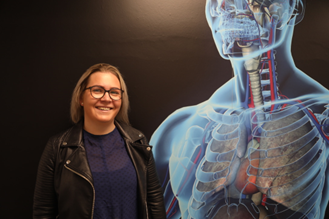
Health and Society student Stephanie smiling at camera in front of a background of a skeleton

"The course is continuing to develop me further, I will be commencing my first teaching role in September 2024; however, I will also be continuing my CPD by continuing with a master’s in education. My Undergraduate program has supported this transition and has been the foundation to go on and develop further. The degree had its own challenges, but the support of my lecturers had not gone unnoticed with their dedication and endless support throughout. No journey like this should be easy due to the level being worked at. But the ongoing support and encouragement is most definitely there. As a disabled student, my accessibility to learning has honestly been some of the best and I hope to take this forward in my own classrooms."

"When I joined university I had no confidence and did not know if I was good enough. Completing my foundation year in health and social care has been the best experience for me. All staff have been very friendly and helpful. Now I am more confident and motivated and I can't wait for level 4!!"

- Gaye Leanne Garland, Health and Social Care with Foundation Year -

"As a mature student and a mom the thought of starting university was daunting., but it is honestly one of the best things I've ever done. I have loved every second, the support received is second to none and the friendships made will be lifelong. If you are in any doubt, do it! What have you got to lose".

- Becky Parker, Public Health with Foundation Year -

"The support and encouragement this first year has been incredible. It has helped me to find confidence in m abilities, and I now see so much potential in myself

This Foundation Year has been invaluable".

- Kerrie Green, Health and Social Care with Foundation Year -

"Over the course of three years this university and degree has helped my development and understanding of the social care sector, as well as health and wellbeing. With the support of the faculty, I have very much enjoyed my time, thank you".

- Zeba (has asked to use first name only), Social Care, Health and Wellbeing

"I am currently doing a social care and health and wellbeing course, which I have enjoyed for the past three years. It has been a pleasure being taught this course by the social care and health and wellbeing team. Overall, the past three years have been blissful. And I have enjoyed every moment!".

- Rubbena (has asked to use first name only), Social Care, Health and Wellbeing -

"I feel that this course has helped open my eyes to different topics and piqued my interest in topics I did not know I was interested in. The support that I have also received from the staff made it even more inspiring and encouraging to see it through!"

  • Paige (has asked to use first name only), Social Care, Health and Wellbeing -

Student testimonials

Helen

“I took part in the Access to Disability Project throughout the first and second year of my degree course. I was fully supported throughout my time as a volunteer by my mentor. I learned about the welfare benefits system through the training that was given as well as the real-life experiences of the people who claim these benefits through spending time with and filling out the forms with them. I gained experience of communication techniques, extracting information and a sense of fulfilment through supporting others and making a positive impact on their lives. The project was a great way to gain some work experience whilst also helping others and gaining knowledge of the welfare benefits system and the problems facing people in the community in everyday life.”

Sharon

“… I have been volunteering for the Access to Disability project for over a year now. The project can help you to fine-tune confidence, communication, and empathy skills. I met people from a wide range of diverse social backgrounds. The project is very rewarding, especially when the outcome is a positive one.”

Students from The Access to Disability Benefits Project

"I honestly didn’t think I would get any money, so thank you.’

‘I didn’t think that I qualified for additional help. The extra money has made so much difference to me."

‘’You have made my life circumstance change I don't know how I would be coping without the service you provided, very grateful."

"… Without a doubt, I am now in a far stronger financial position than previously as a result of the work undertaken on my behalf… your project is doing a superb job."

Tuition Fees Loan (Home Fee Status):

Most students will be able to apply for a loans to pay for these subject to eligibility. To find out more information please refer to the government Student Finance website.

Changes for EU students:

The UK government has confirmed that EU students starting courses from 1 August 2021 will normally be classified as having Overseas Fee status. More information about the change is available at UKCISA:

EU citizens living in the UK with 'settled' status, and Irish nationals living in the UK or Ireland, will still be classified as Home students, providing they meet the usual residency requirements, for more information about EU Settlement Scheme (EUSS)


Self-funding:

If you don’t want to take out a loan to pay your fees or if you aren’t eligible to receive a loan, you might want to take advantage of the University’s scheme to pay by instalments: See How to pay.

For more information please contact the Gateway.


Your employer, embassy or organisation can pay for your Tuition fees:

If your employer, embassy or organisation agrees to pay all or part of your tuition fees; the University will refer to them as your sponsor and will invoice them for the appropriate amount.

We must receive notification of sponsorship in writing as soon as possible, and before enrolment, confirming that the sponsor will pay your tuition fees.


Financial Hardship:

Students can apply to the Dennis Turner Opportunity Fund.

for help with course related costs however this cannot be used for fees or to cover general living costs.


Bursaries and Scholarships:

In addition the University also offers a range of Bursaries and Scholarships packages

You can find more information on the University’s Funding, cost, fee and support pages.

Telephone

01902 32 22 22

Email

enquiries@wlv.ac.uk

Online

Order a prospectus

How we compare

Find out how our course is rated on Discover Uni, the official website for comparing UK higher education courses.

Find out how our course is rated on Discover Uni, the official website for comparing UK higher education courses.

Full-time Course

Part-time Course