Clearing 2026

There's still time to apply – Call us on 01902 968555!  Find out more.

University of Wolverhampton Logo University of Wolverhampton Logo
  • Our Courses
    • Our Courses

      Overview access
    • Types of Courses
      • Types of Courses

        Overview access
      • Undergraduate Courses
      • Postgraduate Courses
      • Research (PhD)
      • Online Distance Learning
      • Degree Apprenticeships
      • CPD Short Courses
    • Career Guides
      • Career Guides

        Overview access
      • Architecture and Construction
      • Business and Law
      • Creative Industries
      • Digital and Cyber
      • Health and Social Care
      • Sport
      • Teaching and Education
    • Make it happen
      • Make it happen

        Overview access
      • Courses A-Z
      • Order a Prospectus
      • How to apply
      • Ask about a course
    • Popular Undergraduate Courses
      • Popular Undergraduate Courses

        Overview access
      • Accounting, Finance and Economics
      • Animal Behaviour and Wildlife Conservation
      • Architecture
      • Biomedical Science
      • Business and Management
      • Civil Engineering and Built Environment
      • Computer Science
      • Engineering
      • English
      • Film, Media and Screen
      • Forensic Science
      • Law
      • Medical Sciences
      • Midwifery
      • Nursing
      • Pharmacy, Pharmaceutical Science and Pharmacology
      • Public Health
      • Social Work and Social Care
      • Sport and Physical Activity
      • Teaching
    • Popular Postgraduate Courses
      • Popular Postgraduate Courses

        Overview access
      • AI and Data Science
      • Architecture
      • Biomedical Science and Microbiology
      • Business
      • Civil Engineering and Built Environment
      • Cyber Security
      • Education
      • Engineering
      • Health Sciences
      • Law
      • Nursing
  • University Life
    • University Life

      Overview access
    • Students' Union
    • Speak to a Student
      • Speak to a Student

        Overview access
      • Make a Course Enquiry
      • Talk to an ambassador
    • WLV Gym
      • WLV Gym

        Overview access
      • Opening Times
      • Facilities
      • Student Memberships
    • Student Support
      • Student Support

        Overview access
      • Mature Students Support
      • Part-time work
      • Student Safety
    • Accommodation
      • Accommodation

        Overview access
      • How do I apply?
      • City Campus
      • Walsall Campus
      • Telford Campus
    • WLV On Demand
    • Our Campus
      • Our Campus

        Overview access
      • Springfield Campus
      • Our Facilities
      • Virtual Tour
      • News and Events
  • Apply
    • Apply

      Overview access
    • How to Apply
      • How to Apply

        Overview access
      • Find the right course for you
      • Making your application
      • After you've applied
      • International Applications
      • Get Set
    • Funding, Costs, Fees, and Support
      • Funding, Costs, Fees, and Support

        Overview access
      • Scholarships
      • Costs and Funding
      • Repayment Options
    • Support and Advice at the Gateway
      • Support and Advice at the Gateway

        Overview access
      • Contact the Gateway
    • Parents and Guardians Hub
  • Research
    • Research

      Overview access
    • About our Research
    • Research Centres
    • Research Policies, Procedures & Guidelines
    • Research Degrees
    • Research Services
    • Research News and Events
    • Access our Expertise
    • Access Research Papers
  • International
    • International

      Overview access
    • Making an Application
      • Making an Application

        Overview access
      • Entry Requirements
      • English Entry Requirements
      • Apply Direct
    • Country Specific Entry Requirements
      • Country Specific Entry Requirements

        Overview access
      • Agents
    • Scholarships
      • Scholarships

        Overview access
      • International Fees
      • How to pay
    • Contact us
  • Our Schools
    • Our Schools

      Overview access
    • Faculty of Arts, Business and Social Sciences
      • Faculty of Arts, Business and Social Sciences

        Overview access
      • School of Social Science, Humanities & Creative Industries
      • School of Business & Law
    • Faculty of Education, Health & Wellbeing
      • Faculty of Education, Health & Wellbeing

        Overview access
      • School of Nursing and Midwifery
      • School of Health and Wellbeing
      • School of Education & Psychology
    • Faculty of Science & Engineering
      • Faculty of Science & Engineering

        Overview access
      • School of Pharmacy & Life Sciences
      • School of Architecture, Computing & Engineering
    • Black Country Medical School
  • Work With Us
    • Work With Us

      Overview access
    • Employers
    • Facilities for Business
      • Facilities for Business

        Overview access
      • National Brownfield Institute
      • University of Wolverhampton Science Park
      • e-Innovation Centre
    • Conferencing
      • Conferencing

        Overview access
      • Conference Booking
      • Venues
      • Dining & Refreshments
    • Apprenticeships
      • Apprenticeships

        Overview access
      • Make an Enquiry
    • Funding & Support
      • Funding & Support

        Overview access
      • Knowledge Transfer Partnerships
      • University Procurement
      • University Jobs
    • Executive Education
      • Executive Education

        Overview access
      • Executive Education Programmes and Courses
      • Accessing our graduate talent pool
    • Schools and Colleges
      • Schools and Colleges

        Overview access
      • General Higher Education sessions
      • Partnerships
      • Aspire to HE
    • University Procurement
      • University Procurement

        Overview access
      • Supplying the University
  • About Us
    • About Us

      Overview access
    • Our Staff
    • Our History
    • Governance 
    • Academic Calendar
    • Equality & Diversity
    • Contacts & Maps
    • Corporate Information
    • University Jobs
    • Security Services
    • Safeguarding
  • News & Events
    • News & Events

      Overview access
    • Open Days
    • Applicant Day
    • Accessibility on Campus
    • Campus Tours
    • Latest News
    • Blog
    • Events
    • Media Relations
    • Follow Our Socials
  • Staff Intranet
    • Staff Intranet

      Overview access
    • Teaching and Research
    • Human Resources
    • Training & Development Opportunities
    • eLearning Portal
    • Staff Wellbeing Hub
    • Staff News
    • Comms Toolkit
  • Current Students
    • Current Students

      Overview access
    • Careers Enterprise and The Workplace
    • Student Support
    • Academic calendar
    • Course Guides
    • Student Voice
    • Student Ambassadors
  • Alumni
    • Alumni

      Overview access
    • Stay in touch – Update your details
    • Benefits & Services
    • Transcripts & Certificates
    • Volunteer Opportunities
    • Make a donation
    • Contact Us
  • University Library
    • University Library

      Overview access
    • Search Library Resources
    • Using the library
    • Subject Resources
    • Skills for learning
  • IT Services
    • IT Services

      Overview access
    • Self Help
    • myWLV
University of Wolverhampton Logo

Our Courses

Overview access
Types of Courses
  • Undergraduate Courses
  • Postgraduate Courses
  • Research (PhD)
  • Online Distance Learning
  • Degree Apprenticeships
  • CPD Short Courses
Career Guides
  • Architecture and Construction
  • Business and Law
  • Creative Industries
  • Digital and Cyber
  • Health and Social Care
  • Sport
  • Teaching and Education
Make it happen
  • Courses A-Z
  • Order a Prospectus
  • How to apply
  • Ask about a course
Popular Undergraduate Courses
  • Accounting, Finance and Economics
  • Animal Behaviour and Wildlife Conservation
  • Architecture
  • Biomedical Science
  • Business and Management
  • Civil Engineering and Built Environment
  • Computer Science
  • Engineering
  • English
  • Film, Media and Screen
  • Forensic Science
  • Law
  • Medical Sciences
  • Midwifery
  • Nursing
  • Pharmacy, Pharmaceutical Science and Pharmacology
  • Public Health
  • Social Work and Social Care
  • Sport and Physical Activity
  • Teaching
Popular Postgraduate Courses
  • AI and Data Science
  • Architecture
  • Biomedical Science and Microbiology
  • Business
  • Civil Engineering and Built Environment
  • Cyber Security
  • Education
  • Engineering
  • Health Sciences
  • Law
  • Nursing
NSS Logo in purple and white, set on an orange background

University celebrates further rise in National Student Survey results

WLV News

Read More

University of Wolverhampton Logo

University Life

Overview access
Students' Union
Speak to a Student
  • Make a Course Enquiry
  • Talk to an ambassador
WLV Gym
  • Opening Times
  • Facilities
  • Student Memberships
Student Support
  • Mature Students Support
  • Part-time work
  • Student Safety
Accommodation
  • How do I apply?
  • City Campus
  • Walsall Campus
  • Telford Campus
WLV On Demand
Our Campus
  • Springfield Campus
  • Our Facilities
  • Virtual Tour
  • News and Events
NSS Logo in purple and white, set on an orange background

University celebrates further rise in National Student Survey results

WLV News

Read More

University of Wolverhampton Logo

Apply

Overview access
How to Apply
  • Find the right course for you
  • Making your application
  • After you've applied
  • International Applications
  • Get Set
Funding, Costs, Fees, and Support
  • Scholarships
  • Costs and Funding
  • Repayment Options
Support and Advice at the Gateway
  • Contact the Gateway
Parents and Guardians Hub
NSS Logo in purple and white, set on an orange background

University celebrates further rise in National Student Survey results

WLV News

Read More

University of Wolverhampton Logo

Research

Overview access
About our Research
Research Centres
Research Policies, Procedures & Guidelines
Research Degrees
Research Services
Research News and Events
Access our Expertise
Access Research Papers
A group of students studying together sitting at a table

Free training highlights new approaches to studying literature in the digital age

WLV News

Read More

University of Wolverhampton Logo

International

Overview access
Making an Application
  • Entry Requirements
  • English Entry Requirements
  • Apply Direct
Country Specific Entry Requirements
  • Agents
Scholarships
  • International Fees
  • How to pay
Contact us
Eighteen athletes from the Indian Weightlifting Team line up for a group photo. They wear sports kit and are holding weights. Behind then are weightlifting machines.

Indian Commonwealth Games Weightlifting Squad chooses University of Wolverhampton as training base

WLV News

Read More

University of Wolverhampton Logo

Our Schools

Overview access
Faculty of Arts, Business and Social Sciences
  • School of Social Science, Humanities & Creative Industries
  • School of Business & Law
Faculty of Education, Health & Wellbeing
  • School of Nursing and Midwifery
  • School of Health and Wellbeing
  • School of Education & Psychology
Faculty of Science & Engineering
  • School of Pharmacy & Life Sciences
  • School of Architecture, Computing & Engineering
Black Country Medical School
Twelve women stand on the steps of a site at Walsall Campus as part of a site tour. They wear casual clothes, hard hats and hi-viz waistcoats and smile for the camera.

University marks Women in Engineering Day with industry event

WLV News

Read More

University of Wolverhampton Logo

Work With Us

Overview access
Employers
Facilities for Business
  • National Brownfield Institute
  • University of Wolverhampton Science Park
  • e-Innovation Centre
Conferencing
  • Conference Booking
  • Venues
  • Dining & Refreshments
Apprenticeships
  • Make an Enquiry
Funding & Support
  • Knowledge Transfer Partnerships
  • University Procurement
  • University Jobs
Executive Education
  • Executive Education Programmes and Courses
  • Accessing our graduate talent pool
Schools and Colleges
  • General Higher Education sessions
  • Partnerships
  • Aspire to HE
University Procurement
  • Supplying the University
NSS Logo in purple and white, set on an orange background

University celebrates further rise in National Student Survey results

WLV News

Read More

University of Wolverhampton Logo
About Us
  • Our Staff
  • Our History
  • Governance 
  • Academic Calendar
  • Equality & Diversity
  • Contacts & Maps
  • Corporate Information
  • University Jobs
  • Security Services
  • Safeguarding
News & Events
  • Open Days
  • Applicant Day
  • Accessibility on Campus
  • Campus Tours
  • Latest News
  • Blog
  • Events
  • Media Relations
  • Follow Our Socials
Staff Intranet
  • Teaching and Research
  • Human Resources
  • Training & Development Opportunities
  • eLearning Portal
  • Staff Wellbeing Hub
  • Staff News
  • Comms Toolkit
Current Students
  • Careers Enterprise and The Workplace
  • Student Support
  • Academic calendar
  • Course Guides
  • Student Voice
  • Student Ambassadors
Alumni
  • Stay in touch – Update your details
  • Benefits & Services
  • Transcripts & Certificates
  • Volunteer Opportunities
  • Make a donation
  • Contact Us
University Library
  • Search Library Resources
  • Using the library
  • Subject Resources
  • Skills for learning
IT Services
  • Self Help
  • myWLV

BUILD THE FUTURE: Degree Apprenticeship breathes new life into careers of prospective midwives

WLV News

Read More

  1. Courses
  2. BEng (Hons) Aerospace Engineering
School of Architecture, Computing and Engineering

BEng (Hons) Aerospace Engineering

BEng (Hons) Full-time 3 years

Design it. Build it. Fly it. Become an aerospace engineer through hands-on projects, industry partnerships and real testing facilities — rated number one in the UK for Aerospace Engineering teaching (NSS 2026)

Register your interest
Apply now Already applied? Login now

Design it. Build it. Fly it. Become an aerospace engineer through hands-on projects, industry partnerships and real testing facilities — rated number one in the UK for Aerospace Engineering teaching (NSS 2026)

Award
BEng (Hons)
Start date(s)
14 September 2026
UCAS Code
H400
Course specifications
View course spec
Course length
Full-time (3 years)
Campus location
University: Springfield Campus
School
School of Architecture, Computing and Engineering
UCAS points calculator
Open Points Calculator
  • Overview
  • Entry Requirements
  • Fees & Finance
  • Modules
  • Employability
Getting an internship going into industry and then coming back to university for my final year has made me feel like I can actually do this, and that I am actually working to become an engineer.
Naledi Misomali, Graduate Aerospace Integration Engineer, BAE Systems -BEng (Hons) Aerospace Engineering

Why choose this course?

The aerospace sector is one of the UK's most competitive and fastest-growing industries, and this course is built to get you into it — not just to teach you about it. From your first term, you'll be working on real engineering problems: designing components, testing them in our wind tunnels, and analysing performance using the same CFD, FEA and MATLAB tools used across the aerospace, motorsport and automotive sectors.

You'll study in the heart of the UK's engineering and manufacturing heartland, with direct routes into an industry that spans the Midlands and beyond. Our relationships with RAF Cosford, MOOG, Marston’s (Collins) Aerospace and Safran give you access to live projects and industry insight that most aerospace degrees can't offer, and every student is guaranteed a professional placement as part of their degree — not an optional extra, but a core part of how you'll build your CV.

The course is accredited by the Institution of Mechanical Engineers (IMechE), and is delivered from our £7m Springfield engineering campus — home to subsonic and supersonic wind tunnels, an aircraft flight demonstrator, metal 3D printing and composite manufacturing labs, and industry-standard CAD, CFD and FEA suites.
Whether you're coming in with strong A-Level grades, a technical BTEC, or you're a mature student with relevant experience, we're set up to help you become a confident, career-ready engineer — without the traditional barriers some aerospace courses put in your way.

And in the 2026 National Student Survey*, Aerospace Engineering at the University of Wolverhampton was rated number one in the UK for Teaching.

*National Student Survey- NSS 2026 Results
This course is currently under review for re-accreditation

What's unique about this course?

  • Work on a full-size aircraft: Get hands-on with our very own two-seater aircraft, working on and around a real aircraft airframe.
  • Real UAV projects, not just theory. Build and fly your own aircraft — compete in the national UAS Challenge and BMFA competitions through the University of Wolverhampton Aerospace (UWA) club, taking a design from concept to test flight.
  • Full wind tunnel suite. Test designs in our subsonic and supersonic wind tunnels, including an aircraft flight demonstrator and F1-specification rolling road wind tunnel — facilities most universities simply don't have.
  • Industry partnerships from year one. Work on live projects and placement opportunities with RAF Cosford, MOOG, Marstan and Safran, gaining insight most students only get after graduating.
  • Guaranteed placement. Every student gets a guaranteed professional placement built into their degree, giving you real workplace experience and a head start on your CV.
  • Industry-standard software and labs. Learn the same CFD, FEA and MATLAB packages used across aerospace, automotive and motorsport engineering, in our composites, thermo-fluids, electronics and materials testing labs.
  • IMechE accredited. Our course meets the AHEP 4 standards set by the Engineering Council and is accredited by the Institution of Mechanical Engineers (IMechE).
  • Genuinely accessible. Accessible entry requirements, strong academic support, and a clear route into engineering careers — this is where you become an engineer, wherever you're starting from.

What happens on the course?

Across three years, you'll move from mastering core engineering principles to specialising in aerospace design, analysis and enterprise — with practical projects running alongside your studies every step of the way.

Year One: Building your foundations

You'll get to grips with the engineering fundamentals that underpin everything else on the course — statics, thermodynamics, fluid mechanics, materials science and electronics — alongside your first introduction to industry-standard CAD, CFD and FEA software. This isn't just lecture-based learning:

  • Design, build and test your own aerospace components in our state-of-the-art laboratories. to design, build.
  • Take part in an aerospace industry linked group project with one of our academic partners, building teamwork, communication and project management skills alongside the technical work – become highly employable.
  • Study alongside students from other engineering disciplines, widening your network from day one.

Year Two: Specialising in aerospace

Your learning goes deeper into aerospace-specific territory — thermofluids, aircraft propulsion, instrumentation and control — while your computational skills in CFD and FEA are pushed further with real structural and fluid-flow problems. A year-long Enterprising Group Innovation Project puts you into a multidisciplinary team tackling a genuine industry challenge, from vehicle performance to sustainable propulsion. This is also when most students take up their guaranteed placement year, gaining hands-on industry experience before returning to complete the degree.

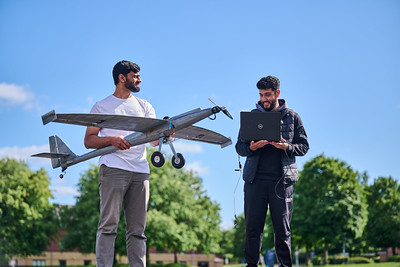
2 students stood at runway. One holding a UAV the other holding a laptop.

Year Three: Designing and leading

In your final year, you'll be taught by lecturers with direct aerospace industry experience, using our wind tunnel facilities to experimentally test and evaluate your own designs under real-world conditions. Two major projects anchor the year:

  • Group Aircraft Design and Enterprise: Design and build a complete aircraft system with your team, taking on the responsibilities of a professional design environment — culminating in you presenting your work at our annual Innovations Unleashed event alongside industry leaders.
  • Individual Innovation Project: Plan, execute and report on an original engineering project of your own choosing, working with academic or industry supervisors wherever possible — your chance to show what you can do as an engineer, ready for graduate-level work.

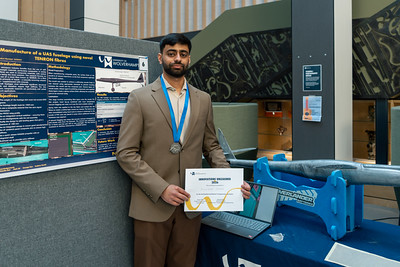
student standing proudly with prize at the innovations engineering showcase. They are stood in front of their final year project.

If you want to go further, our MEng Aerospace Engineering builds on this with advanced flight dynamics and control, aircraft propulsion systems, and further CFD and heat transfer study.

Placements on the course

Every student on this course is guaranteed a professional placement as part of their degree — real work experience, built in, not something you have to find and arrange yourself. Placements vary in format: some students get hands-on experience directly in aerospace, others take on a remote live industry brief, and others work in an adjacent engineering sector — but all of them are structured to leave you genuinely prepared for the workplace before you graduate.

Broader than just aerospace engineering. Placements won't always sit directly within an aerospace role, but they're chosen to build the transferable workplace skills — professionalism, communication, teamwork, time management — that every engineering employer expects from day one.

Alongside this, our relationships with RAF Cosford, MOOG, Marstan (Collins) Aerospace and Safran mean you're building industry contacts from your first year, not just during your placement search. Whatever form your placement takes, you leave with proven work experience, a stronger CV, and a much clearer sense of where you fit in the engineering world.

Employability on the course

Every student on this course is guaranteed a professional placement — real work experience built into the degree, not something you have to find and arrange yourself. Placements vary in format: some students work directly in aerospace, others take on a remote live industry brief, and others sit in an adjacent engineering sector — but all are chosen to build the transferable workplace skills employers expect from day one, and to leave you genuinely prepared before you graduate.

Our relationships with RAF Cosford, MOOG, Collins Aerospace and Safran mean you're building your network with genuine aerospace, defence and advanced engineering employers from your first year — not just in your final placement search. Recent graduates have gone straight into technical engineering roles: Edward Green (Class of 2024) is now a Technical Engineer at Tungaloy-NTK UK.

What this course prepares you for:

  • Industry-aligned curriculum. A curriculum mapped directly to what aerospace, automotive and advanced engineering employers are looking for.
  • Transferable skills built in. Problem-solving, teamwork, communication and adaptability, developed through every group project and placement.
  • A genuine bridge into employment. Structured support to move from student to working engineer, including employability workshops, engineering seminars and industry field trips.

Careers our graduates go into:

  • Aerospace Design Engineer — working on airframe structures, control surfaces or interior systems using CAD and simulation tools.
  • Propulsion Engineer — developing and testing jet engines, gas turbines or sustainable aviation propulsion.
  • Flight Systems Engineer — integrating mechanical and electronic subsystems for reliable aircraft operation.
  • Structural Engineer — running stress analysis and material selection on lightweight or composite aerospace structures.
  • Spacecraft or Satellite Engineer — supporting design, thermal control or orbital mechanics work.
  • Test and Evaluation Engineer — verifying aerospace components meet airworthiness and certification standards.
  • Systems Integration Engineer — overseeing avionics, propulsion and control systems working together.
  • Roles in research and development, aerospace manufacturing, and high-performance technical consultancy spanning motorsport and aerospace.

Course Modules

Year 1 Year 2 Year 3
Module: 4MA032
Credits: 40
Period: 1
Type: Core

Engineering analysis is the cornerstone of understanding and solving complex real-world problems. You will be introduced to industrial-leading engineering analysis software packages in Finite Element Analysis (FEA) and Computational Fluid Dynamics (CFD) offering insights into numerical methods used in engineering design and analysis. Through theoretical learning and practical exercises, you will develop the mathematical and analytical skills necessary to tackle complex engineering problems and gain valuable insights into computer-aided engineering techniques.

Module: 4MA033
Credits: 40
Period: 1
Type: Core

This module aims to develop your practical skillset practical on various engineering aspects in our state-of-the-art laboratories. You will build your expertise in computer aided design and practice this in an industry-linked group activity offered by our partners . This group activity will offer you the opportunity to interact with industrial partners and build highly sought skills including risk, stakeholder and security analysis, communication, teamwork and project management skills. At the end of the module, you will be versed in the entire engineering process of analysing a brief, designing a solution, testing and reporting, all key milestones in the engineering profession.

Module: 4MA031
Credits: 40
Period: 1
Type: Core

This module provides a comprehensive introduction to key engineering principles essential for understanding engineering systems. You will explore a range of topics such as statics, thermodynamics, fluid mechanics, kinematics, electronics, and materials science. You will develop a solid foundation in fundamental engineering concepts, which will allow you to achieve broad understanding.

Module: 5MA046
Credits: 40
Period: 2
Type: Core

Applied computational analysis provides students with a comprehensive understanding of structural and fluid behaviour. This module applies cutting-edge engineering knowledge to advanced topics such as deformation, failure analysis, and fluid flow. Through practical application using Finite Element Analysis (FEA) and Computational Fluid Dynamics (CFD), students will develop applied computational skills essential for engineering design, analysis and validation employed in mechanical engineering industries from automotive, to motorsport and aerospace.

Module: 5MA047
Credits: 20
Period: 2
Type: Core

In this module, you will develop a comprehensive understanding of control systems. You will focus on the control principles including components, circuit design, and system control. You will gain hands-on experience in designing, operating, and troubleshooting control and instrumentation systems via rigorous hands-on laboratory activities, which will prepare you for a career in various engineering sectors, from automotive to aviation and signal analysis to name a few.

Module: 5MA049
Credits: 40
Period: 2
Type: Core

The course offers students the opportunity to address real-world innovation challenges in the automotive and motorsport fields. Participants will engage in collaborative efforts within multidisciplinary teams, combining technical knowledge with entrepreneurial skills to formulate pioneering solutions. The focus of the projects will include vehicle performance, electric and hybrid propulsion, sustainability, and motorsport engineering. Collaborations with industry partners will yield important insights, empowering students to leverage emerging technologies and explore novel business models. By the end of the course, students will have developed practical solutions and acquired essential experience for their future careers in these fast-paced sectors.

Module: 5MA051
Credits: 20
Period: 2
Type: Core

In this module, you will investigate the underlying principles of thermodynamic cycles and fluids analysis exhibited by a range of aerospace engine types and fuel systems. You will conduct detailed analysis on heat transfer mechanics within propulsion systems including electrical and hydrogen powered transportation systems.

Module: 6MA055
Credits: 40
Period: 3
Type: Core

In this module students will advance their study in digital design and manufacturing, focusing on key aspects of engineering analysis and high-level understanding of how objects move through our atmosphere. Students will explore advanced topics such as stress analysis and failure, vibration, advanced finite element analysis (FEA), and computational fluid dynamics (CFD) for supersonic and subsonic aerodynamics. Machine Design and toolpath generation also play a part in this module as do the selection of materials such as aerospace composites. Through theoretical learning and practical exercises, students will develop advanced skills using digital design tools and manufacturing processes, preparing them for the challenges of the modern engineering industry.

Module: 6MA056
Credits: 40
Period: 3
Type: Core

This module empowers students to take part in a sustained practical project centred on aircraft design to demonstrate their skills, knowledge, and design sensibilities. Furthermore, students will deepen their understanding and enhance their skills to mirror professional practices in aircraft design environments and the team scenario. Moreover, you will showcase high levels of creativity, assess project management and risk mitigation, whilst considering environmental impact.

Module: 6MA054
Credits: 40
Period: 3
Type: Core

In this module you will undertake an innovative engineering project encompassing all your acquired engineering skills, knowledge and creativity. Your project can involve design, research, experimentation or computational solution. You will identify and plan your project following a rigorous assessment of project management, environmental, societal and provide an in-depth analysis of the commercial context of your solution. You will then execute the project under the supervision of academics or industrial partners, wherever possible, and provide a new solution to a real-world problem embedding risk and security management and strong communication skills. Upon completion, you will be ready for the challenges of the engineering industry or further academic pursuits.

Potential Career Paths

You!

Aerospace Design Engineer

Propulsion Engineer

Flight Systems Engineer

Structural Engineer

Spacecraft or Satellite Engineer

Test and Evaluation Engineer

Systems Integration Engineer

Aerospace Design Engineer

Contribute to the design and development of aircraft, spacecraft, or drones. You may work on airframe structures, control surfaces, or interior systems, using CAD software and simulation tools.

Propulsion Engineer

Focus on the development, testing, and optimisation of propulsion systems such as jet engines, gas turbines, or rocket motors. This includes both traditional and sustainable aviation technologies.

Flight Systems Engineer

Work on flight control, navigation, and autopilot systems, ensuring the integration of mechanical and electronic subsystems for reliable aircraft operation.

Structural Engineer

Carry out stress analysis, fatigue testing, and material selection to ensure that aerospace structures meet strict safety and performance standards, particularly for lightweight or composite components.

Spacecraft or Satellite Engineer

Support the design, launch, and operation of satellites or small spacecraft. This includes work on structural design, thermal control, communications systems, or orbital mechanics.

Test and Evaluation Engineer

Conduct ground-based or in-flight testing of aerospace components and systems, analysing data to verify compliance with airworthiness and certification requirements.

Systems Integration Engineer

Oversee the integration of complex systems such as avionics, propulsion, and control systems within aircraft or spacecraft. This role ensures that all components work seamlessly together under real-world conditions.

Contribute to the design and development of aircraft, spacecraft, or drones. You may work on airframe structures, control surfaces, or interior systems, using CAD software and simulation tools.

Focus on the development, testing, and optimisation of propulsion systems such as jet engines, gas turbines, or rocket motors. This includes both traditional and sustainable aviation technologies.

Work on flight control, navigation, and autopilot systems, ensuring the integration of mechanical and electronic subsystems for reliable aircraft operation.

Carry out stress analysis, fatigue testing, and material selection to ensure that aerospace structures meet strict safety and performance standards, particularly for lightweight or composite components.

Support the design, launch, and operation of satellites or small spacecraft. This includes work on structural design, thermal control, communications systems, or orbital mechanics.

Conduct ground-based or in-flight testing of aerospace components and systems, analysing data to verify compliance with airworthiness and certification requirements.

Oversee the integration of complex systems such as avionics, propulsion, and control systems within aircraft or spacecraft. This role ensures that all components work seamlessly together under real-world conditions.

Additional Information

Everything you need to know about this course!

Our engineering courses are built around problem- and activity-based learning and live industrial project work — not just lectures. Every course is designed to meet the latest Engineering Council accreditation standards, and Aerospace Engineering is accredited by the Institution of Mechanical Engineers (IMechE).

We've invested over £7m in new engineering facilities at our Springfield Campus, responding directly to the regional and national shortage of graduate-qualified engineers. That investment means you get access to subsonic and supersonic wind tunnels (including an F1-specification rolling road wind tunnel), an aircraft flight demonstrator, engine test facilities, composites and materials testing labs, and metal 3D printing — technology genuinely at the forefront of engineering development.

It's not all lectures and labs. Outside your timetable, you can join hands-on clubs like the Flight Simulator Club. There's also the University of Wolverhampton Aerospace (UWA) club, a student activity that puts your design and build skills into practice. Through UWA, you can compete in the British Model Flying Association (BMFA) Challenge and the national UAS Challenge, or get involved in re-engineering our very own two-seater aircraft. These aren't just fun extras: they're where you build real engineering components, apply industry-standard procedures, and build a CV that stands out.

We're based in the heart of the UK's engineering and manufacturing region, within easy reach of major aerospace, automotive and supply chain employers — and we back that up with a supportive, accessible learning environment, from academic skills support through our library's Skills for Learning programme to dedicated wellbeing and disability support services.

It all adds up to consistently strong results: the University improved across every theme in the National Student Survey 2026, performing above sector benchmark, and has been recognised in the WhatUni Student Choice Awards among the UK's leading institutions for student experience.

By graduation, you'll have developed the full range of skills expected of a professional aerospace engineer, mapped against the Engineering Council's AHEP 4 standards:

  • Science & Maths. Apply advanced mathematics, statistics and natural science principles to analyse and solve complex aerospace engineering problems.
  • Engineering Analysis. Use computational and analytical techniques — including CFD, FEA and MATLAB — alongside technical literature to model and address real aerospace challenges.
  • Design & Innovation. Design integrated aerospace solutions that balance safety, environmental impact, cost and performance for genuinely complex problems.
  • The Engineer & Society. Evaluate the environmental and societal impact of your engineering decisions, and make ethical, informed choices as a professional engineer.
  • Engineering Practice. Develop hands-on skills across materials, technologies and manufacturing processes, while managing risk, ensuring quality and communicating clearly.
  • Research & Development. Conceptualise, plan and deliver a complex aerospace project independently, supported by literature review and critical milestones, and report on it to a professional standard.

Location Mode Sep intake Fee Year
Home Full-time £9790 per year 2026-27
International Full-time £17600 per year 2026-27

The University is committed to a transparent fee structure, with no hidden costs, to help you make an informed decision. This includes information on what is included in the fee and how fees are calculated and reviewed.


If a tuition fee is not showing, we may not offer this intake for this course. Please check the start date information on the course finder for start dates.

GCSE English and Mathematics at grades 4/C+ or an acceptable equivalent qualification.

Please note we do NOT accept GCSE Short Courses

PLUS EITHER

  • 80 UCAS points including a Level 3 qualification in Mathematics and another subject in either Physics, Chemistry, Design Technology, Further Mathematics, Electronics, Computing, ICT or Engineering. Excluding General Studies or Critical Thinking
  • A Levels - grades CDD including a Mathematics at grade C and another subject in either Physics, Chemistry, Design Technology, Further Mathematics, Electronics, Computing, ICT or Engineering. Excluding General Studies or Critical Thinking
  • BTEC L3 Extended Diploma or OCR Cambridge L3 Technical Extended Diploma – grade MMP in an Engineering subject to include Mathematics
  • BTEC L3 Diploma – grade DM in an Engineering subject to include Mathematics
  • Access to HE Diploma (60 credits) of which a minimum of 45 must be at Level 3 (80 UCAS point equivalence) in an Engineering subject to include Mathematics.
  • T-Levels - overall grade of Pass and a minimum grade of C in Core in an Engineering subject; Design Development Engineering, Maintenance, Installation and repair for Engineering or Engineering, Manufacturing, Processing and Control

Use the UCAS Tariff calculator to check your qualifications and points

Students must usually have studied for a minimum of two years post GCSE level. However, we will consider applications from mature students who do not have two years of post-16 study, where they have relevant work experience. Please see http://wlv.ac.uk/mature for further information.

If you've got other qualifications or relevant experience, please contact The Gateway for further advice before applying.

International entry requirements and application guidance can be found at http://www.wlv.ac.uk/international/apply

English language requirements also apply

“Since I started my BEng Aerospace Engineering course with the University of Wolverhampton, I have been able to advance my theoretical knowledge. Starting with the basic principles of what makes an aircraft fly and the varying forces applied to that aircraft. Currently in my second year, I can further those skills by partaking in a more focused subject with various systems within aircraft. With this university I was also able to take extracurricular activities, partaking in designing a fuselage for a UAS Drone challenge”. Daniel Copson – BEng Aerospace Engineering with Foundation Year student and UWA Student Design Engineer.

“Aerospace Engineering is an interesting degree to study with many exciting extracurricular activities alongside the course, which students can pursue. For example, the IMechE UAS challenge creates a big learning curve for all those involved, as well as providing opportunities whereby all theoretical knowledge gained from study can be applied to a real-life scenario, taking students from design to manufacture and test flying their UAS. All of this gives students essential experience in working in the aviation industry”. Jake Adams – BEng Aerospace Engineering student and UWA Student team leader.

"I am employed in an aerospace engineering role that I would not have been able to get if it wasn’t for my degree. The modules I learned have given me an insight into the engineering world and provided me with skills necessary to choosing my career path and becoming successful in the future." Oliver Hickman - BEng Aerospace Engineering graduate 2021


Tuition Fees Loan (Home Fee Status):

Most students will be able to apply for a loans to pay for these subject to eligibility. To find out more information please refer to the government Student Finance website.

Changes for EU students:

The UK government has confirmed that EU students starting courses from 1 August 2021 will normally be classified as having Overseas Fee status. More information about the change is available at UKCISA:

EU citizens living in the UK with 'settled' status, and Irish nationals living in the UK or Ireland, will still be classified as Home students, providing they meet the usual residency requirements, for more information about EU Settlement Scheme (EUSS)


Self-funding:

If you don’t want to take out a loan to pay your fees or if you aren’t eligible to receive a loan, you might want to take advantage of the University’s scheme to pay by instalments: See How to pay.

For more information please contact the Gateway.


Your employer, embassy or organisation can pay for your Tuition fees:

If your employer, embassy or organisation agrees to pay all or part of your tuition fees; the University will refer to them as your sponsor and will invoice them for the appropriate amount.

We must receive notification of sponsorship in writing as soon as possible, and before enrolment, confirming that the sponsor will pay your tuition fees.


Financial Hardship:

Students can apply to the Dennis Turner Opportunity Fund.

for help with course related costs however this cannot be used for fees or to cover general living costs.


Bursaries and Scholarships:

In addition the University also offers a range of Bursaries and Scholarships packages

You can find more information on the University’s Funding, cost, fee and support pages.

Telephone

01902 32 22 22

Email

enquiries@wlv.ac.uk

Online

Order a prospectus

How we compare

Find out how our course is rated on Discover Uni, the official website for comparing UK higher education courses.

Find out how our course is rated on Discover Uni, the official website for comparing UK higher education courses.

Full-time Course

Make it happen

Order a prospectus Visit an Open Day
Ask a student about University Life

Related Courses

BSc (Hons) Construction Management
BSc (Hons) Computer Science
BSc (Hons) Construction Management
BSc (Hons) Computer Science

Your recently viewed courses Recently Viewed

Apply for Aerospace Engineering
BEng (Hons) Full-time 3 years
Course Options
Location Study mode Duration Start date  
University: Springfield Campus Full-time 3 years 14 September 2026 Apply via UCAS

University of Wolverhampton

Wulfruna Street
Wolverhampton
WV1 1LY

  • Tel: 01902 321000
  • Useful Contacts
  • Maps and Directions
  • University Jobs

Current Students

  • Current Students Homepage
  • Canvas
  • Library
  • E:Vision
  • Academic Calendar

For Parents

  • Student Safety
  • Fees & Funding
  • Schools & Institutes

For Businesses

  • Research
  • Funding and Support
  • Conferences
  • Hire a Graduate
  • Executive Education

For Staff

  • Staff Intranet
  • A-Z Staff Services
  • Digital Services
  • Human Resources
  • Facebook (Open in New Tab)
  • X, formerly known as Twitter (Open in New Tab)
  • Instagram (Open in New Tab)
  • LinkedIn (Open in New Tab)
  • Privacy Policy
  • Legal Information
  • Corporate Statements
  • Incident Reporting
  • Cookie Policy
  • Accessibility Statement
  • Modern Day Slavery Statement
  • Zero Tolerance Statement
  • © 2022 All Rights Reserved
Fairtrade
StoneWall Top 100 Employer 2018
QS Stars Rating System 2022
Search