

/prod01/wlvacuk/media/departments/digital-content-and-communications/images-2026/Claire-Macdonald-graduate---courtyard-2-wolf-resized.jpg)
/prod01/wlvacuk/media/departments/digital-content-and-communications/submitted-news-images/nss2026_800x400-1.jpg)
/prod01/wlvacuk/media/departments/digital-content-and-communications/CTU-2.jpg)
/prod01/wlvacuk/media/departments/digital-content-and-communications/submitted-news-images/Indian-weightlifting-team.JPG)
/prod01/wlvacuk/media/departments/digital-content-and-communications/Adopting-AI-for-Business.jpg)
/prod01/wlvacuk/media/departments/digital-content-and-communications/submitted-news-images/54505138639_670536a9d0_c.jpg)
/prod01/wlvacuk/media/departments/research/mobile-cyber.jpg)
AgenticDeviceShield: An Autonomous and Explainable Cyber Defence on Mobile Devices Using Knowledge Augmented Agentic AI


Led by Dr. Md Arafatur Rahman, in collaboration with Dr. Nazmul Hussain (University of Lancashire), AgenticDeviceShield aims to develop an autonomous, privacy preserving cyber defence system that runs directly on personal and mobile smart devices. The project is funded by Innovate UK, bringing together expertise in artificial intelligence (AI), cybersecurity and human‑centred computing.
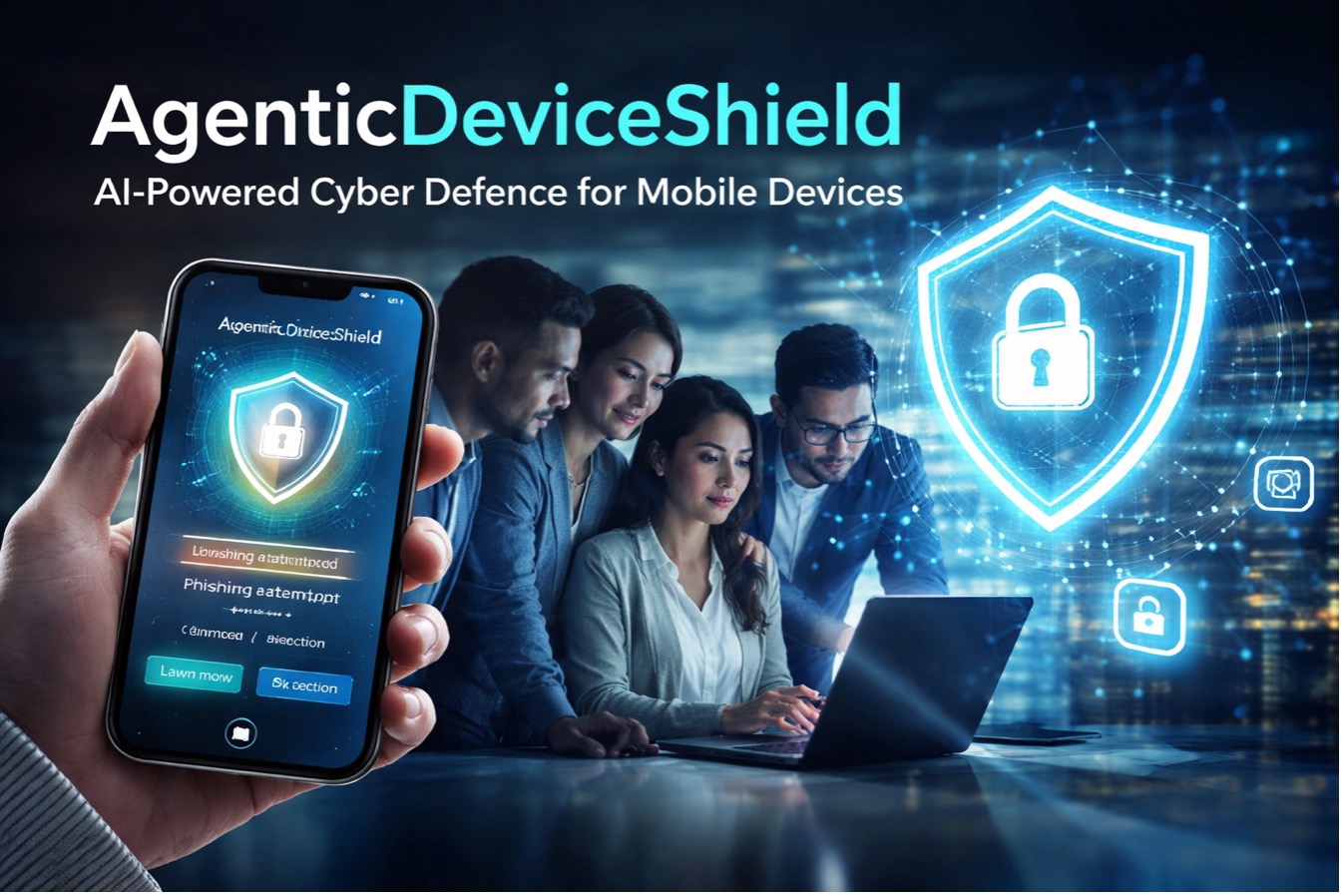 The project addresses the growing threat of mobile cyberattacks such as AI‑driven phishing, deepfake scams, malicious apps and spyware that exploits human behaviour and often bypass existing mobile security tools. Current solutions are largely cloud‑dependent, reactive and difficult for non‑expert users to understand, leaving many people, particularly less digitally confident users, at risk.
AgenticDeviceShield uses lightweight, knowledge‑augmented agentic AI to continuously monitor device activity and reason about threats locally, without sending personal data to the cloud. By operating entirely on‑device, the system delivers real‑time, low‑latency and offline‑resilient protection while preserving user privacy. Importantly, it provides clear natural‑language explanations of risks and defensive actions so users can understand and trust the system regardless of technical expertise.
The project reflects a growing recognition that cybersecurity is not just a technical issue, but a societal one, requiring solutions that are trustworthy, transparent and designed around real human needs.
Our real world impact
The anticipated impact of the project is the creation of a credible pathway for AgenticDeviceShield to move beyond academic research and towards commercial and societal adoption. By validating the market need, early adopter segments, and commercial potential of an autonomous, explainable, and privacy-preserving mobile cyber defence solution, the project will support the development of a technology that can improve digital safety for individuals, organisations, and vulnerable users.
The innovation has the potential to reduce exposure to mobile phishing, spyware, malicious applications, and AI-enabled scams, particularly for people who rely on smartphones as their primary access point to essential digital services. Beyond academia, the project is expected to influence industry practice by promoting more user-centric, on-device, and explainable approaches to cybersecurity. It will also strengthen collaboration between universities, commercial partners, and end users, creating opportunities for licensing, spin-out activity, follow-on investment, and wider societal benefit through improved cyber resilience and digital inclusion.
Conducting the research
The research will be conducted through a structured two-part approach focused on value proposition development and market validation. First, the team will refine the innovation’s core proposition by analysing the problem, target users, and competitive landscape, drawing on prior research in agentic AI, knowledge-augmented reasoning, and mobile cybersecurity. This phase will include technical review, stakeholder mapping, and preparation of demonstrator materials.
Second, the team will undertake market validation through structured interviews, focus groups, and engagement with priority stakeholders, including mobile and endpoint security vendors, SMEs operating BYOD environments, privacy-focused app developers, and organisations supporting digitally vulnerable users. The activity will test perceived value, usability, trust, and willingness to adopt or license the solution. Findings will be synthesised to identify early adopter segments, validate problem-solution fit, and determine the most credible commercialisation route, supported by the University of Lancashire’s and University of Wolverhampton’s Technology Transfer Offices.
Why it matters
The project is to confirm that mobile cyber risk is both significant and underserved, particularly for individuals, SMEs, and digitally vulnerable users who rely heavily on smartphones and tablets for essential services. We expect to find strong demand for a privacy-preserving, on-device cyber defence solution that does not depend on constant cloud connectivity and that provides clear, user-friendly explanations of threats and defensive actions.
The activity is also expected to identify the customer segments most likely to adopt the technology early, such as BYOD-based professional organisations, privacy-focused application providers, and organisations supporting vulnerable users. In addition, we expect to clarify the most viable commercialisation pathway, whether through licensing to established cybersecurity vendors or through a spin-out model. These findings matter because they will reduce commercial uncertainty, validate problem-solution fit, and provide the evidence needed to move the innovation from academic research towards credible market adoption and real-world impact.
The project team
The project brings together academics from both the University of Wolverhampton and University of Lancashire.
University of Wolverhampton Professor Md Arafatur Rahman said:
“AgenticDeviceShield represents a shift towards security systems that can reason, explain and act locally – creating protection that is both intelligent and humane.”
University of Lancashire Dr Nazmul Hussain said:
"Mobile devices have become people’s lifeline to the digital world. Our goal is to make that access safer without requiring users to be cybersecurity experts or to sacrifice their privacy.”