/prod01/wlvacuk/media/departments/digital-content-and-communications/submitted-news-images/Wolves-Women-interview.jpg)
/prod01/wlvacuk/media/departments/digital-content-and-communications/submitted-news-images/CLS-cohort-2024.jpeg)
/prod01/wlvacuk/media/departments/digital-content-and-communications/images-18-19/beinghuman_teaser.jpg)
/prod01/wlvacuk/media/departments/digital-content-and-communications/submitted-news-images/Espanyol-FC-exchange.jpg)
/prod01/wlvacuk/media/departments/digital-content-and-communications/submitted-news-images/Varsity.jpg)
/prod01/wlvacuk/media/departments/digital-content-and-communications/submitted-news-images/WMBF-business-festival.jpg)
/prod01/wlvacuk/media/departments/digital-content-and-communications/submitted-news-images/WUSCAs-Shortlist-tile-1.png)
The Media Superstars of World War One: Sterling Ladies FC - The Dagenham Invincibles - Part 3
02/02/2026 - 1.02
Steve Bolton
Maud Reader - Star Centre Midfield
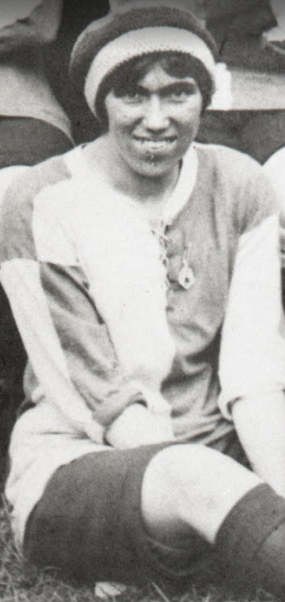
Maud Reader
Source: Courtesy Valence House Archives, Dagenham
Maud Reader - Gypsy, Roma, Traveller Heritage?
Maud Reader was an important regular in the team. She played in the very first game and she played in the very last game. Sterling's last game took place in April 1919. It was an away game in Chelmsford in the pouring rain against the mighty Hoffmanns (vast ball bearing and tank rollers factory, bigger than Marconi). She scored the two winning goals in their 2-0 win, thus sealing Sterling's place in history as the Dagenham Invincibles.
Extensive research by a descendant of the Reader family has been very kindly shared with me. Author Grant Bage has also very kindly shared his research and knowledge with me. Maud and her family grew up by ‘The Heath’ as close neighbours of the Ramsey family. Whatever Maud’s heritage and background, we can see from the evidence so far that she was a much cherished, skilled and valued member of one of the most important football teams in the history of women’s football, if not football history as a whole. This will be the subject of a further article. My thanks to Kathryn and Grant.
The "Invincibles Play" by Amanda Whittington

Book of the Play by Amanda Whittington
Celebrated in Culture
1917: World War One is raging in Europe. In Britain, Sterling Ladies – known as the Dagenham Invincibles – are playing to win. For two whirlwind seasons, they never lose a game. Yet once peace is restored, the factory girls must hang up their boots and see triumph fade into obscurity.
2023: Injured footballer Maya follows England's progress through the Women's World Cup. The world has changed, yet the roar of the Lionesses echoes the Invincibles' war-cry. Watching at home, Maya fears she'll never play again – but as she loses herself in the present, she hears the call of the past and finds fresh hope for the future.
Amanda Whittington's play The Invincibles celebrates two generations of inspirational women, and their adventures on the football pitch a century apart. It premiered at the Queen's Theatre, Hornchurch, in 2023, and offers rich opportunities for other theatre companies looking to score a hit with their audiences.
I was the historical consultant for this amazing play by Amanda. I urge everyone to buy the book (less than £10) and go and see it if you get the chance. See if you can spot the Brian Clough quote that lifelong Nottingham Forest fan Amanda sneaks into the dialogue!!
Headgate Theatre, Colchester
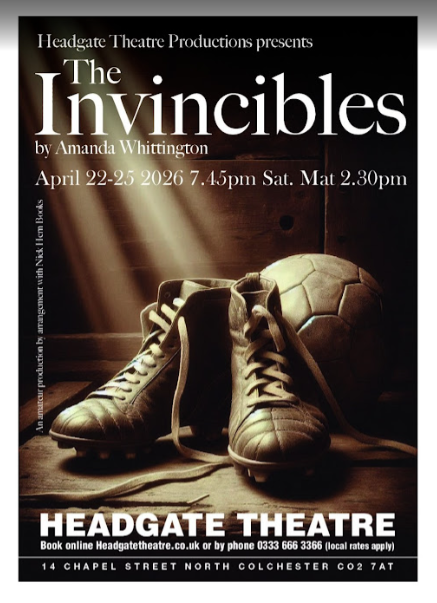
“The Invincibles” - Headgate Theatre - April 2026
Source: Image Courtesy of Headgate Theatre
Support Local Theatre
Amanda’s amazing play has featured all over the world since its inaugural run in September 2023, at the Queens Theatre in Hornchurch and The New Wolsey Theatre in Ipswich. The rights for an amateur production are available through Nick Hern Books and casting can run from 7-10 female and 2-5 male plus ensemble cast. Staging can be as simple or as complicated as the Director chooses. The play has been performed so far (to my knowledge) by:
● LAMDA
● Broughton Players at the Preston Playhouse (I went to school in Broughton!!)
● Tudor Players in the Library Theatre in Sheffield
● First Act Arts in the Brindley Theatre, Runcorn
● Aschcam Middle School, Sydney, Australia
The Headgate Theatre is a small, vibrant theatre in the middle of Britain’s first city, Colchester, famous for its Roman heritage with the original name of Camulodunum. The theatre itself is an architectural gem, originally a 19th century Chapel. Director Paul T Davies states that he has had an astonishing amount of support from the community, including Colchester United Football Club. The play has been one of the easiest to cast and crew. On Thursday 5 March 2026 ‘Creative in Colchester’ are supporting a talk and exhibition about the Invincibles to mark International Women’s Day and raise money for #HerGameToo at the theatre. I am often asked in media interviews what my famous international footballing granny would have thought of women’s football today. I find myself wondering what those ordinary working class Dagenham women would have thought about inspiring today’s footballers and football fans and being celebrated in culture? This sort of fabulous community art must continue to be supported and thrive.
The Misogynistic Conspiracy Theory Myth
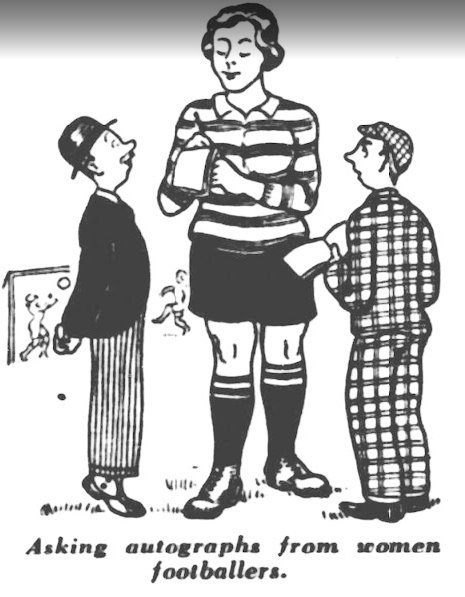
Fear of ‘Amazons’
Source: BNA
Some Inconvenient Truths
“A bunch of nasty men got together in 1921 and banned women’s football. It disappeared completely and then started up again in 1971, when the men allowed it.” This is how the history of women’s football is usually presented and I now believe that this is wrong. More than that, it is unhelpful to future development. The fixation with the 1921 ban assumes that there were no women of influence for 50 years, ignores the inconvenient truth that they were generally of the middle class establishment and were vigorously opposed to women playing football. The purpose of this article is to celebrate the first Media Superstars of women’s football, the Dagenham Invincibles. Here follows some context. I am simply going to state my views and a more in-depth argument with research back-up can wait for an article dedicated to that purpose.
My view is that English society was not ‘ready’ for a large expansion of ‘working class’ women playing football until post the 1966 men’s world cup. That is not to say that there were not significant challenges and barriers. Importantly though, this is when we see a number of leagues forming, particularly in the Midlands. It is my view that there were two ‘golden eras’ of women’s football:
1st Golden Era - World War 1 - Particularly the 1917-1918 and 1918-1919 ‘war seasons’.
2nd Golden Era - 1920-1921 Season
This presents the question: Why did we have these golden eras, some 50-ish years before we were ready as a society?
We had a total war which turned societal norms on their head, temporarily. If it was necessary for men to sacrifice their bodies and their health fighting on the front line, then women wearing skimpy clothing and playing the male impact game of football, possibly damaging their bodies for future motherhood was likewise an outcome of the country fighting for its future. My impression is that most women footballers from this era accepted the ending of this peculiar situation with alacrity. In many ways, my thought is that they probably felt that the ending of the war and the return of the menfolk was a way to ‘get on with their lives’. I haven’t performed a thorough analysis but I have found evidence that several of the Sterlings married very shortly after the war, or in Maud Smith’s case, during the war. The 1921 ban came 3 years after the end of the war and had nothing to do with it.
Conclusion
Made In Dagenham and Made In St Helens
This is a very personal story for me. My granny Lizzy Ashcroft’s magnificent career with the St Helens Ladies only started in April 1921 and had basically come to an end a few months later thanks to the October and December 1921 FA Resolutions. It was only the fact that St Helens thrashed the Dick Kerr Ladies 5-1 in 1923, that she was able to continue her amazing career until retirement in 1935.
I want to make it quite clear that I think the 1921 ban was wrong.
I am, however, absolutely convinced that the FA of the time were honourable ‘Victorian gentlemen’, who felt that they were doing the right thing and protecting women. As a historian, I have amassed quite an amount of evidence to support this point of view. I would urge anyone who is interested, as a starting point, to read Sir Frederick Wall’s 1935 autobiography. One of things that surprised me in my research was the barriers put in the way of women’s football by influential women during the 1920s and 1930s. Again, I have amassed a lot of evidence and it wasn’t just football that was regarded as not suitable for girls and women. I have found prohibitions against rugby, boxing, distance running and rowing. My friend Amanda Whittington, who it a top historian herself, has a great phrase for this: ‘bigger wheels were in motion’. Suzy Wrack’s book ‘A Woman’s Game’ does a great job at looking at the laws and diktats post World War Two, which tried to force women back into domestic roles. If asked, I would rather have tried to run a women’s football team in 1935 than in 1955.
There are two main points that I would like the reader to take from this article. The first is that women’s football enjoyed its first golden era due to a cataclysmic event, total war. After the war and particularly in the calendar year 1919, women’s football almost entirely disappeared. I have found no evidence to alter my view that the vast majority of women footballers accepted this fact and got on with their lives. As more and more institutions get interested in this history they seem preoccupied with ‘the ban’. The 1921 ban had nothing to do with this amazing era of women’s football. By the end of the 1918-1919 war season, over 250 teams played over 1000 games to raise a fortune for the war effort. This is a beautiful thing in very dark times and should, I think, be positively celebrated. The second golden era came about for very different reasons. Yes, it was due to the war, but it was long after the war had finished and it was because we had a completely broken country. Families starved to death in our major cities and riots took place all over the country due to poverty and unemployment. Two distinct categories of women’s football took place, ‘pea soup football’ and what I term the ‘high profile charity model’. ‘Pea soup football’ is the term typically used to describe local community football in areas of industrial dispute where wives, girlfriends and female relatives would play, whilst tins were rattled to collect money to keep people in food. This type of football had a resurgence in 1926 and I thoroughly recommend the work of Professor Alethea Melling and Patrick Brennan.
The second point that I would like to emphasise is just how special the media coverage of the Sterlings was in this first golden era. Apart from the Portsmouth Ladies, nearly all football in this era is only covered locally. I am aware of some counter examples but statistically I don’t think they disprove my point. The nearest that I can find to this media interest is two years later when the second golden era begins due to the visit of the French national team for a four game tour against the Preston team the Dick Kerr Ladies. The evidence that I have for this is significant. During World War One, the Dick Kerr Ladies played 30 games and lost four of them (possibly five). Nearly all articles about these games are featured in the Preston Herald or the other Preston newspaper the Lancashire Evening Post (the LEP despite its name is actually a Preston paper). There are a couple of games towards the end of the 1918-1919 season where a combined Preston/Bolton team takes on a Tyneside munitions team called ‘Newcastle’ where obviously there is some coverage in Newcastle as well. Rather tellingly, I think, is the gap between the Dick Kerr Ladies last game of the 1918-1919 season, which was played on 31st May 1919, to their first game of the 1919-1920 season. Their next game was not until 7th February 1920, over eight months later. Prior to the first French game nearly three months later on 30th April they managed five games against ‘Liverpool Ladies’ which is basically the ex-munitionettes of the area. So, in eight ‘football months’ they have managed five games, and they lost two. This is not giving manager Alfred Frankland much chance to brand his team the ‘unbeaten lady champions’ and I am not surprised that no more games were arranged against ‘Liverpool’. The French tour was one of the most important tours in the history of women’s football. It ‘lit the spark’ for the second golden era. This golden era came to an end thanks largely to the actions and influence of the FA in October and December 1921.
I want to make it quite clear that in my view the Dick Kerr Ladies are the greatest women’s football team of all time and I am so proud of my granny’s 13 years with them. However, out of historical accuracy, I think it should be recognised that they did not become famous until April/May 1920. This was long after the end of World War One.
As well as the Pathe clips photographs of the Sterlings featured in the Daily Mirror, the Illustrated Sporting and Dramatic News, Picturegoer Magazine, Kinematograph Weekly, Glasgow Daily Record, The Tatler, Birmingham Daily Gazette, Sheffield Independent, The Daily Herald, The Tampa Times, The Winnipeg Tribune, The New York Herald and probably others that I haven’t located. They were media superstars.
Any history of women’s football should start with the Sterlings front and centre.
I have had the great honour for the last three years of laying a wreath at the Cenotaph in London 11th November to remember the contribution of the women munitionette footballers of World War One, as part of the football contingent. This is thanks to the amazing folk at the Western Front Association which promotes the memory of the Great War. The ‘golden team’ of the first ‘golden era’ was the Sterlings, with 34 wins and 2 draws. The Invincibles…
The Sterlings shone briefly, but ever so brightly and we should remember them.
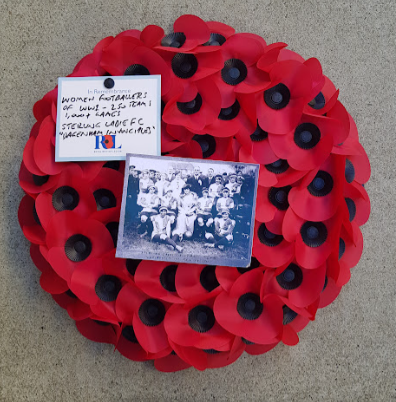
11th Hour, 11th Day, 11th Month
Source: Steve Bolton Collection
Biography
Steve Bolton was awarded a BSc (Hons) in Mathematics from University College London) and a Post Graduate Certificate in Education from the University of Nottingham. Steve’s passion is researching and writing about the history of women’s football. I have had several articles published and he is currently working on his first book: “Granny Played Football”. Granny Lizzy Ashcroft was one of the most influential and important pre-WW2 women’s footballers. She made her debut at the age of 16 for St Helens Ladies at St Andrews in April 1921 in front of a crowd of 30,000. After the English FA ban she joined the Dick Kerr Ladies in 1923 where she played until her retirement in 1935. She was Vice-Captain under Lily Parr from 1932-1934 and in 1935 took over the captaincy from her great mate Lily and led the DKL only their second ever continental tour. Steve is custodian of the Lizzy Ashcroft Collection which is one of the foremost collections of pre-World War Two women’s football memorabilia in private hands.
Steve’s Twitter handle is: @DagenhamInvince and he can be contacted by email at: lizzyashcroftfootballer@gmail.com