/prod01/wlvacuk/media/departments/digital-content-and-communications/submitted-news-images/Josh-Helen-Pride26-speeches-closeup.png)
/prod01/wlvacuk/media/departments/digital-content-and-communications/images-2024-25/250630-SciFest-1-group-photo-resized-800x450.png)
/prod01/wlvacuk/media/departments/digital-content-and-communications/submitted-news-images/Kiran-Gulia.jpeg)
/prod01/wlvacuk/media/departments/digital-content-and-communications/images-2026/QS-Five-Star.jpg)
Football’s First War
21/04/2026 - 11.53
Roger Slater
Some of the language and terms in this piece reflect the reports and information of the time. They are included here for context and accuracy and there is no intention to cause upset or offence, and if any is so caused, then please accept this as an apology.
‘Rabbit holing’ for another dive into the depths of minutiae that is football history, you’ll always find an unexpected path, follow it, then another, then another, then they all come back together! This toe in the water has uncovered three separate stories that become one. The first, a growth if not a birth of football in the Victorian era ‘Whites Only’ Orange Free State in South Africa that started in Suffolk – and then their ‘Blacks Only’ Touring Team, Bantu XI. Finally, each of these run into the Second Boer War - Football’s First War.
Let me explain!
Football’s First War is where this little piece of history ends, but it starts, all be it briefly, in Suffolk, England in 1859, with the birth of Fred Ringer. His life and times in Suffolk are in the main, unrecorded, except to say that he was a player for both Unity FC and Gresham FC. A bit of digging around on t’interweb proved entirely fruitless in regard to either club in Suffolk in the late 1870s, the period chosen as it would reflect the twentieth year of Fred Ringer, and a period when there was every chance he’d be playing football. All was not lost however, as there were both Unity FC and Gresham FC in London in that era, so not too great a jump to think he may have moved home. That jump by the way, was into Ancestry UK, where I soon found Frederick Michael Ringer, born 1859 in Fressingfield, Suffolk, to parents William and Ellen Ringer, the youngest of their five children, though another daughter was soon added to the family.
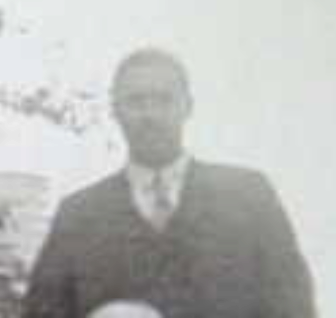
Fred Ringer c1885. Source: Author’s Collection
Back to Unity FC and Gresham FC. Unity FC was a Departmental side of a London department store, William Tarn & Co. They were based in Elephant and Castle and following the 1878-79 season when they won eight and drew eight of their 20 matches. They entered the FA Cup for the first time the following season, though they actually withdrew after being drawn away to Remnants FC of Windsor.
Sadly, little else is recorded of Unity, but Fred Ringer, I think, I have found representing Gresham FC. The Gresham club was formed in Peckham Rye in 1874 and in 1878 a match report remains of a fixture away to Finchley in which F. Ringer scored their only goal in a 6-1 defeat.
The Hendon & Finchley Times, 19th October 1878. Source: The British Newspaper Archive
Move on a couple of years, and Fred Ringer was in South Africa, to be precise, he was in Orange Free State, at Bloemfontein, where he married Mary Margaret O’Connor and they too had five children. More importantly, for this story, a year later, Fred Ringer who had emigrated to South Africa around 1891, landed and settled at Heilbron, where he began to introduce Association Football to the local Afrikaners. He also founded the Heilbron Club and was instrumental in the formation of the Orange Free State Football Association. The OFSFA introduced a cup competition in 1895, and it was somewhat appropriately won by the Heilbron Club and celebrated in the press photograph Fred Ringer commissioned.
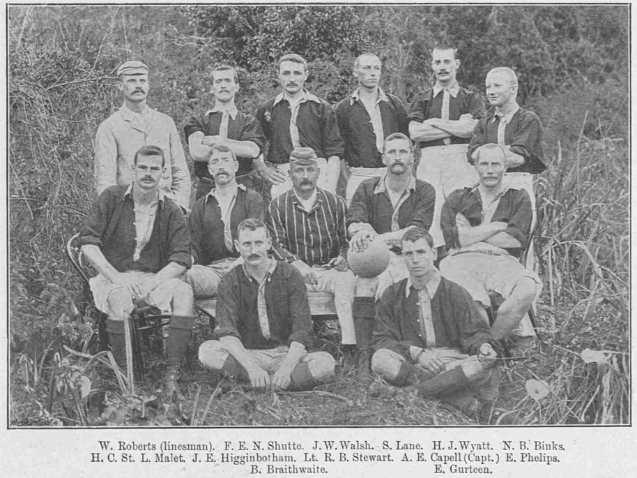
The Illustrated Sporting and Dramatic News, February 8th 1896. Source: The British Newspaper Archive
What we can be sure of, is that at the time the OFSFA and its leagues and competitions were, like all sport in South Africa, split by colour. The OFSFA operated a ‘Whites Only’ policy which makes the next part of this story all the more unusual. For context, the policy did not change until the early 1990s.
In 1887, Corinthians, an English Amateur side undertook their first tour of South Africa and played 23 matches against local sides. The tour was a success, helped develop football in the country and it seems seeded the idea of a reciprocal tour where a South African side would tour the United Kingdom. In June 1899, the English Press reported that such a tour would soon take place, the touring side being Bantu XI, a representative side from the Orange Free State, who were sponsored and backed for the tour by the OFSFA. Nothing surprising in that, until you realise that the touring party of sixteen players and four officials was made up of sixteen black players and four white officials, a combination that almost certainly would not have been allowed to play at all in their home country.
The tour was to last four months and would see 43 matches played in England, Scotland, Wales and Northern Ireland but little detail was included in the early press coverage beyond the colour of the players. They soon became known by the derogatory “Kaffir Team” or “Kaffir Footballers” in headlines and reports, even before they had arrived at Southampton, after a journey of over three weeks by sea! The Kaffir Tour as it was named by the press led to the team being known variously as The Orange Free State Football Team, Bantu XI and also Bantus.
In fact, they missed their boat connection at Cape Town, and their arrival was delayed by nine days, which led to the cancellation of two early fixtures that were then rescheduled for later in the tour.
There was little mention in the reports of the tensions between South Africa, The Orange Free State and the British (settlers, soldiers and administrators) that controlled Cape Colony and Natal, the British presence alone in conflict with the Boer republics which had a large population of Dutch descent (incidentally, including my Grand and Great Grandparents and generations before them), excepting in the last lines of a report from the Morning Leader (below). Mr M. W. Williams of Llanelly, was the tour representative in the UK, and interviewed about the imminent arrival, he added some insight and detail to the Bantu team. He also mentioned that Mr Chamberlain MP had been invited to kick-off the first game. The interview was to close with a question from the reporter: ‘Any Boers in the team?’ ‘Not one’ responded Mr Williams, ‘Neither are there any savages amongst them’ he added, with a smile.
Morning Leader, 21st August 1899. Source: The British Newspaper Archive
Once the team arrived, the Newcastle Daily Chronicle among other press sources stated that the visitors were ‘…a fine lot of men, and they are reputed to possess remarkable staying powers. They are known to be clever at the game, and it is likely that our home players will find some warm work in store.’ All this hyperbole for a team in which the most experienced player had only been playing football for five years, and others in the squad less than that.
After a tiring 24-day journey they had arrived at Southampton on 2nd September, travelled to their London base, on the 3rd September and on Tuesday 5th September they undertook another journey to Newcastle for their first match against United. It was the start of a gruelling schedule of 40 matches in around 120 days. At the time, it was also anticipated that the team would then immediately take up invitations to tour Germany and Austria-Hungary, where like the UK they had been invited to play some of the leading teams.
The sixteen players in the Bantu XI squad were Thomas, Adolph (goalkeeper), Daniells, Apollis, Davids, Brown, Kennedy, Laking, Mohn, Zwagi, Bothloko, Broffitt, Kortie or Koslie, Stevens, Abel, Twayi or Twazi (captain), Nicholas and Solomon, but surprisingly after the interest of the press preceding the tour, little is actually available to record the games played.
Even the first match against Newcastle United at St James Park received minimal coverage, as the report from The Sporting Life below shows.
The Sporting Life Report on the First Tour Match. Source: British Newspaper Archive
In fact, to open the tour (with 16 players) they played on three consecutive nights, losing 6-3 v Newcastle, 5-3 v Sunderland and 7-3 v Middlesbrough. It set the tone for the tour and the schedule became no easier. From the north east they travelled south to Scarborough to play on 9th September (lost 9-3) then north to Scotland to Face Hibernian (11/9, lost 3-2), Morton (13/9, lost 7-6). Defeats then followed at Ayr Parkhouse, Hamilton Academicals, Dundee and Glasgow Celtic and on September 23rd, they were defeated in Northern Ireland by Belfast Celtic. In three weeks, they had played and lost 11 times.
Reports on the performances, sporadic as they were had a common theme. The players were fit and quick, but lacked many of the skills of the game, no least, each player seemed intent on ‘solo performance’ – they’d win the ball and press forward with no thought of passing to a teammate, and they were also prone to robbing the ball off their own players as much as they were the opponents. Some newspapers even reported that the tour was nothing more than a ‘commercial exhibition’, though in truth the supporters at the matches seemed to be enjoying the performance. Crowds were regularly numbering in the thousands, and the visiting side were well supported throughout – some fans even booing their own clubs when they scored and cheering the Bantu XI when they scored, as they did in every match on the tour bar one.
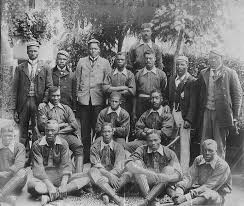
Bantu Squad, sadly unnamed in the image found across t’interweb. Source: Author’s Collection
The tour continued into October but politically, the situation had changed. On the 9th of October, the Boer Republics issued an ultimatum to the British Government, demanding the withdrawal of British troops from their borders, and it was rejected. Two days later, The Boers declared war on the British in South Africa. The Boers were from two independent republics, that of Transvaal, the South African Republic and The Orange Free State, the home state of the touring football team. Almost immediately, the team Captain and Spokesman Joseph Twayi confirmed his team’s support for ‘the Mother Queen’, Victoria and the British and from then on, the team’s blue shorts and orange shirts were adorned with red, white and blue ribbons. This ensured the tour continued with greater support at matches for the side, and when they did play the rescheduled match against Aston Villa, they donated their share of the match receipts to the local ‘War Fund’ in support of the British fighting overseas.
In South Africa, the war was primarily fought between the white Boers and British. Both sides agreed initially not to arm the black South Africans and these local men on both sides became a labour corps and non-combatants, though this did change a little in the latter stages of the conflict.
By the beginning of January, the tour had run its course and the Bantu Team were to return home. The tour had been a commercial failure and reports stated that it was unlikely to ever be repeated, though there is no doubt that supporters had enjoyed the spectacle of the matches. The side had achieved a draw at Derby County and had also travelled across to France for one match against Sporting Club Tourcoing, which turned out to be their only victory, by three goals to one.
The war they were returning to continued and nothing identifies the conflict as Football’s First War better than these two snippets from the same column of The Tamworth Herald of 13th January 1900. The first, just a simple statement repeated verbatim in numerous publications across the country to say that the touring party had left on their journey home, while the second reports that a number of mid-Cheshire amateur footballers had decided that their skills and fitness would better serve on the South African veld than the football arena. They had joined Captain Moseley Leigh’s squad of Imperial Yeomanry.
The Tamworth Herald, 13th January 1900. Source: The British Newspaper Archive
As the month of January 1900 progressed, similar reports appeared in local newspapers from the north through Yorkshire to the south and south west as the Totnes Weekly Times also reported that in Buckfastleigh ‘The war in South Africa will affect the local football team considerably, as three of its members, Lieutenants WP Hamlyn (captain) and BS Johnson will go out with the Yeomanry, and Private J Furneaux (Volunteer) is going to the front’. Alongside the money from fundraising football matches staged – just like the Bantu Team at Aston Villa – players too were strongly supporting the British Army in the conflict.
‘The Sphere: An Illustrated Newspaper for the Home’ first published in 1900, often carried pictures of various Regiment and Battalion football teams. As the British Army of the time expanded for war by recruiting more volunteers (including the footballers above and their peers), so the number of teams grew. No surprise then, that soldiers taken prisoner wanted to play the game, as a letter to The Times in 1902 identified. Written by captured British soldiers in a Boer Prison Camp, a request was made to the people at home for footballs and kit to be supplied. It was a common theme for the period of this war and for the two Great Wars that were to follow. Regional and local papers too carried comment ‘from their correspondent’ such as that below from the Sheffield Independent quoting ‘One of the British prisoners in Pretoria, a Private in the Durham Light Infantry, writing to his friends at home, bears grateful witness to the kind treatment which all the captives have received from the Boers…’ he continues ‘…all the prisoners are in the best of health and spirits, and constantly play football and cricket...’. No doubt an element of positive propaganda to keep spirits up at home, but also a reflection of what happens when a number of men, held in a secure environment, will do to pass the time.
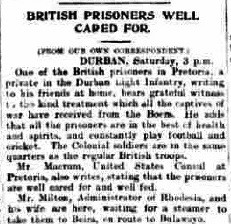
Sheffield Independent 1st January 1900. Source: The British Newspaper Archive
Also from ‘The Sphere’, I came across the illustration below. They are Boer Prisoners of War playing football in a British PoW Camp, all be it this was actually Boer prisoners captured in South Africa and transported to the East of India, to the Sialkot Prison Camp in what is now Pakistan (where the prison remains in use today) and they are playing a match against their Guards from the Gordon Highlanders. It was a common occurrence and there are reports too of matches between groups of prisoners with armed guards at each corner of the pitch.
With so many prisoners held in India, in Bermuda and in Sri Lanka, the risk of any worthwhile escape was minimal and there are notes of ‘prison teams’ playing football, cricket and rugby matches against local sides in Colombo and other camps as Football’s First War progressed.
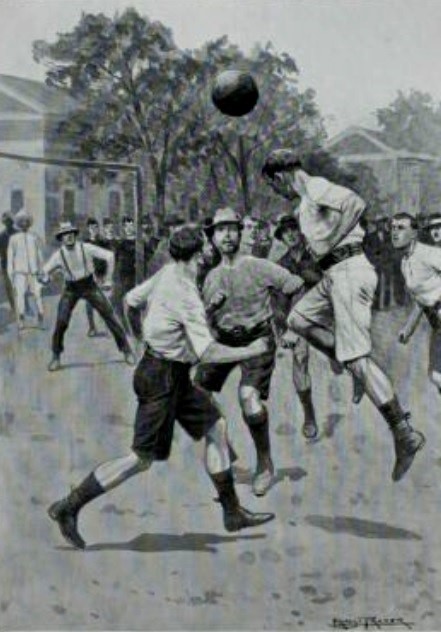
The Sphere, 5th April 1902 - Boer Prisoners at Sialkot Prison Camp play a match against their guards, soldiers from the Gordon Highlanders. Source: Author’s Collection
The results of the tour were as follows:
1899
5 September - Newcastle United - lost 6-3
6 September – Sunderland - lost 5-3
7 September – Middlesbrough - lost 7-3
9 September - Scarborough - lost 9-3
11 September – Hibernian - lost 3-2
13 September – Morton - lost 7-6
15 September - Ayr Parkhouse - lost 6-5
16 September - Hamilton Academicals - lost 6-5
20 September – Dundee - lost 6-4
21 September - Celtic (Glasgow) - lost 2–0 or 2-1
23 September - Celtic (Belfast) - lost 5-3
27 September - Everton - lost 9-3
2 October - Burton Swifts - lost 5-4
4 October - Manchester City - lost 5-3
7 October - Leicester Fosse - lost 7-3
9 October - Northampton Town - lost 7-4
12 October - Nottingham Forest - lost 6-3
14 October – Barnsley - lost 8-5
18 October - Derby County - drew 6-6
21 October - Lincoln City Reserves - lost 9-5
23 October - Sheffield United - lost 7-2
25 October – Loughborough - lost 7-4
28 October - Bolton Wanderers - lost 13-3
30 October – Burnley - lost 7-6
6 November - Preston North End - lost 5-3
7 November - Bradford & District- lost 8-6
11 November - Wrexham - lost 5-4
15 November - Druids- lost 4-3
16 November - Shrewsbury Town - lost 7-5
20 November - Aston Villa - lost 7-4
22 November - West Bromwich Albion - lost 11-6
25 November – Wellingborough - lost 7-5
27 November - Tottenham Hotspur - lost 6-4
29 November - Richmond Association - lost 8-4
4 December - Luton Town - lost 8-6
6 December - Portsmouth Reserves - lost 7-3
7 December – Ryde - lost 5-3
9 December – Cowes - lost 5-3
13 December - Gravesend United - lost 5-4
16 December - Sheppey United - lost 4-3
17 December - Sporting Club Tourcoing - won 3-1
20 December - Reading - lost 9-5
23 December - Ealing - abandoned due to weather
25 December - Brentford - lost 3-2
26 December - Brighton United - lost 10-5
27 December - Dorset County - lost 8-3
30 December – Bournemouth - lost 2-1
1900
1 January - Bristol City - lost 6-5
2 January – Aberdare - lost 7-3
Note
A version of this article was published in the Where’s The Bar magazine.
Find out more about the magazine at - https://www.wheresthebar.co.uk
Biography
Roger Slater was born in Harrow in the late 1950s and has moved around a bit and retired to Devon with wife of 24 years, Helen. He originally trained as an Electrical Engineer but worked for almost 40 years in Building Services Technologies, primarily HVAC control systems and Electronic Security. Roger retired in 2018 having run his own Engineering Consultancy for almost 15 years.
For relaxation and hobbies, he writes, mainly about his football club, Wealdstone FC and has published eight books including a club history since 2002. He does not class himself as a historian, just an enthusiastic amateur.
He also writes for a fanzine/magazine called Where’s The Bar that has just relaunched.
Otherwise, hobbies are upcycling and building ‘strange’ lighting out of people’s rubbish and occasionally painting, though he also buys and sells at auctions and on the internet (mainly football related or antiques).
In respect of other sports, he will watch most but follows the Toronto Blue Jays avidly in baseball, as a result of working on and off in Canada in the early nineties.
Roger also reads and collects books on World War One, in particular personal biographies and war diaries as opposed to battle histories…
All of that could change tomorrow or on any other day if something else takes his fancy as he will give most things a try if they appeal!!