

/prod01/wlvacuk/media/departments/digital-content-and-communications/submitted-news-images/Mr-Speaker-2.jpeg)
POLICY/PROCEDURE
The University has a statutory duty to ensure, so far as is reasonably practicable, the health, safety, and welfare of all its employees, students, visitors, and contractors.
A risk assessment is an important step in protecting all members of the University community, as well as complying with the law. It helps us to focus on the risks that really matter in our workplace – the ones with the potential to cause harm (significant risks). In many instances, straightforward measures can readily control risks, for example, ensuring spillages are cleaned up promptly, so people do not slip, or cupboard drawers kept closed to ensure people do not trip. For most, that means simple, cheap, and effective measures to ensure our community is protected.
The legal duty to undertake risk assessments is explicitly required by The Management of Health and Safety at Work Regulations 1999 (Regulation 3) which states:
“Every employer shall make a suitable and sufficient assessment of:
- The risks to the health and safety of their employees to which they are exposed whilst they are at work; and
- The risks to the health and safety of persons not in their employment arising out of or in connection with the conduct by them of their undertakings”
In summary this means that the risks to the health and safety of employees and anyone else as a result of the work activity must be risk assessed.
This document is issued under the University’s Health and Safety Policy. It will be reviewed in line with the university policy review process.
In addition to the legal requirements there are several further reasons why every responsible employer should use risk assessment, some of the main reasons include:
- Reduction in accidents, injuries, ill health, and fatalities.
- Increases in quality standards, efficiency, and productivity.
- Reduction of costs of injuries and ill health.
- Improved targeting of resources.
- Good management practice.
The Risk Assessment Policy applies to all employees of the University including those who are within a probationary period. The responsibilities and organisational arrangements for the Risk Assessment Policy lie with a variety of personnel within the University, details of which are set out below:
University staff who fail to adhere to the terms of this policy may be subject to disciplinary action, up to and including dismissal.
The risk assessment process is a careful examination of what in your work, could cause harm to people (staff, students, apprentice learners, members of the public, contractors). This enables you to decide whether you have taken enough precautions or should do more to prevent harm. The aim is to make sure that no one gets hurt or becomes ill.
Accidents and ill health can ruin lives and impede the effective operation of the University.
It is important to decide whether a hazard is significant, and whether you have covered it by satisfactory precautions so that the risk of harm is low. People often confuse the terms “hazard” and “risk” and their meanings are frequently transposed.
- Hazard: is something having the potential to cause harm (e.g., chemicals, working from ladders, electricity). However, it is not just the hazard it is how the hazard could cause harm e.g., electricity – this could be ‘electric shock’ or even ‘fire’, dependent on the circumstances. Always think about how the hazard can cause harm.
- Risk: is the probability or likelihood, great or small that injury will result from the hazard.
It is the responsibility of the Deans and Professional Services Directors to ensure that the risk assessments required by these regulations are carried out within their Faculty/Professional Service Department. They should nominate appropriate members of staff in each work area to carry out the risk assessments using the appropriate forms.
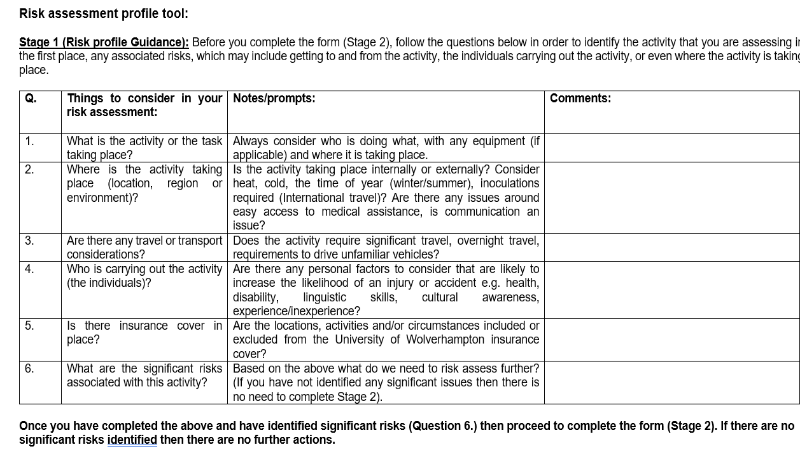
The findings, where they cannot be controlled locally should then be reported to the appropriate Line Manager who will take the necessary action to control the risk in question in an appropriate timescale depending on whether the risk is low, medium, or high. If the action required is outside the remit of their authority then the matter must be escalated, to the Dean or Professional Service Director, if necessary, as they will have the final responsibility for health and safety within the Faculty/Professional Service Department. Should risks remain with a residual risk score greater than 6, Deans and Directors should consider whether the risk is included on an appropriate risk register.
It is important not to overcomplicate the risk assessment process. In a lot of cases the hazards are few and simple. Checking them is nothing more than common sense. In many cases you will probably already know what you have present in the workplace that could cause harm. If so, check that you have taken what reasonable precautions you can to avoid injury. It is also very important to think if a hazard being realised is ‘reasonably foreseeable’ or not. Could we have reasonably expected it to happen? If we can then it needs to be addressed. It is important to add that some hazards identified may require a more specialised risk assessment carried out, for example, chemicals, fire, manual handling/lifting. If this is the case, it is important to get the right people involved in the assessment.
The University risk assessment process includes the following steps:
- List the hazards (Hazards description)
- List those at risk
- Evaluate the risk (Initial assessment)
- Control measures
- Residual risk
- Further action required
- Record your findings
The process is based around the Health and Safety Executive (HSE) Guidance – Five steps to risk assessment: however, the University procedure is a six-stage process as the assessment looks at both the initial risk and the risk when all existing controls have been considered (Residual Risk).
The risk assessment process is a requirement under a number of other pieces of Health and Safety legislation, some of which include the following:
- Control of Substances Hazardous to Health (COSHH) 2002, (as amended);
- Control of Noise at Work Regulations 2005.
- The Control of Asbestos Regulations 2012.
- The Management of Health and Safety at Work Regulations 1999.
- The Health and Safety (Young Persons) Regulations 1997.
- The Health and Safety (Display Screen Equipment) Regulations 1992.
- The Manual Handling Operations Regulations 1992 (as amended).
- The Personal Protective Equipment at Work Regulations 1992 (as amended 2022)
- The Ionising Radiations Regulations 2017.
- Regulatory Reform (Fire Safety) Order 200.
It is also important to remember that risk assessment is required in some specific aspects of work activity, these may include:
- Lone working.
- Pregnant workers.
- Field trip safety.
- Student Placements.
- International travel.
A step-by-step guide to completing the risk assessment form.
List the Hazards (Hazard Description)
Walk around your workplace and look at what could reasonably be expected to cause harm. Ignore the trivial and concentrate only on significant hazards, which could result in serious harm or affect several people. Ask your employees or their representatives what they think. They may have noticed things, which are not immediately obvious. It is also advisable to consult with manufacturers’ instructions or hazard data sheets to help you spot hazards and put the risks in their true perspective. Use the following examples as a guide:
- Mechanical hazards (e.g., crushing, shearing, cutting, falling objects entanglement)
- Electrical hazards (e.g., short circuit, direct contact, indirect contact, source of ignition)
- Radiation hazards (e.g., lasers, electro-magnetic effects, ionising/non-ionising radiation)
- Hazardous substances (e.g., Toxic gas/mist/fumes/dust, flammable fluids, biological substances)
- Work activity hazards (e.g., highly repetitive actions, mental overload/stress, poor workplace design, lifting and handling, proximity to others requiring ‘social distancing’ )
- Work environment hazards (e.g., noise, vibration, heating, lighting, ventilation)
This is not a comprehensive list of hazards; it should be used as a guide.
|
Guidance: Always remember the following:
|
List those at risk (people at risk)
It is important to consider who may be affected by the risks present. The individuals most likely to be at risk are those that spend the most time in the workplace. However, it is equally important to think about people who may not be in the workplace all the time, e.g., cleaners, visitors, contractors, maintenance personnel, students. It is also important to include members of the public and people you may share your workplace with, if there is a chance they could be hurt by your activities. Some categories of workers may require a more detailed assessment because of their condition, including expectant and nursing mothers, individuals with a disability, young persons, or lone workers.
Evaluate the risks (Initial assessment)
The next stage of the assessment, once the hazards and people at risk have been identified is to establish the level of risk before any control measures have been put into place. The process is as follows:
- Work environment hazards (e.g., noise, vibration, heating, lighting, ventilation)
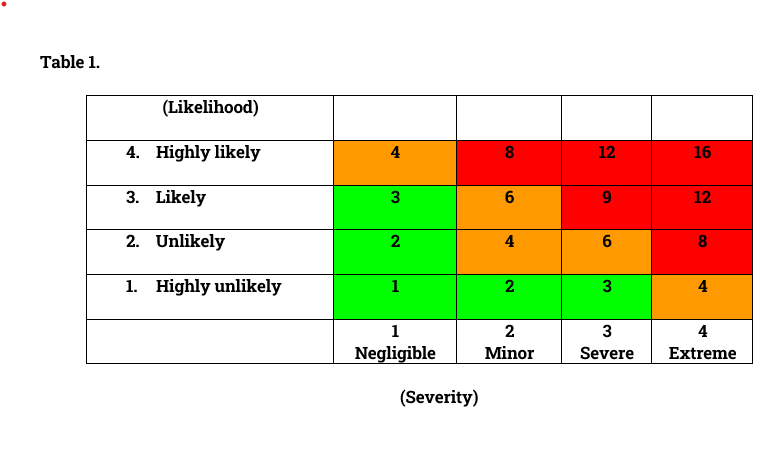
- Rate the likely Severity (S) of any hazard being realised on a scale of 1 to 4 (1 is Negligible, 4 is Extreme or Fatal).
- Multiply the Severity and the Likelihood to find the Risk Factor (R), for example a Severity of 3 and a Likelihood of 2 would give a risk factor of 6.
- Assess if the level of risk is acceptable or not.
It is important to remember at this stage you are assessing the Risk Factor without any control measures put in place, this will happen when the section on Residual Risks is completed.
In order to score your risk factor, you can use the table (table 1) below as a simple guide. The table also provides a useful ‘heat map’ of where you will have hazards that are currently under control or further action is required.
Control Measures
After evaluating the initial risks, it is then important to review what existing controls are already or are being put in place. When looking at control measures the most important starting point is always to implement the ‘Hierarchy of Control’ (see below), this will assess the different ways a hazard can be reduced or removed.
This process also highlights the point that whilst providing Personal Protective Equipment (PPE) is a consideration, as a control measure it should always be down the list of options.
The Hierarchy of Control
- Elimination or avoidance (i.e., does the process/activity have to be carried out?).
- Substitution (i.e., what alternatives can be used, for example, chemicals, processes, equipment).
- Controlling risks at source (i.e., can the hazards be designed out?).
- Separation and isolation (i.e., physically separating or isolating the process/activity, ‘socially distance’ from colleagues or students).
- Safe working procedures (i.e., are these in place and known to individuals taking part?).
- Training, instruction, and supervision (i.e., are all staff competent enough to carry out their duties?).
- Personal Protection Equipment - PPE (the last resort but also to supplement some of the other controls).
Other considerations
- Welfare facilities
- First aid facilities
- Emergency procedures
The ‘Hierarchy of Control’ should always be used in the order it appears on the list, this means starting with whether you can eliminate or avoid the hazard. Risk Assessors should then work down the list and introduce the most appropriate means of controlling the risk. Once again it must be stressed that simply issuing PPE is not the first option, in fact, it is almost the last thing that should be considered. The best form of control is usually to implement the most appropriate measures from 1 to 4 and then also introduce the measures from 5 to 8 to re-enforce the controls.
|
Guidance: When controlling the risks, apply these principles, if possible, in this order:
|
The Residual Risk
Once all the control measures have been put in place the remaining or residual risk must then be assessed. This will follow the same process as the ‘Initial Assessment’ with the result being a Risk Factor (R) score i.e., L x S=R. The residual risk is the risk of the control measures failing and not the risk of an accident happening.
Even after all precautions have been taken, usually some risks remain. What has to be decided for each significant hazard is whether the remaining risk is, high, medium, or low. This will determine whether any further controls are still necessary in order to make the process as safe as is reasonably practicable. It is also important at this point that the risk assessment is an honest one, for example, you must not give a risk a deliberately low score in order for there to be no further action required.
Remember if the process is hazardous, giving it a low score on an assessment form will not make the process any safer, this has to be done through acting upon the findings of your initial assessment.
Further Action Required
Once the Residual Risk Factor (R) has been established there may still be further actions or controls that need to be put in place. This may still mean the elimination or substitution of a process/substance, or it may simply be a need for the introduction of safe systems of working or additional training, instruction, or information to employees.
It is important that when any Actions/Comments are identified, there must be responsibility for carrying these actions out given to an individual or group of individuals. This is important as ownership has to be taken for different parts of the risk assessment process and where individuals have been given specific responsibilities, they should be informed of what is expected of them and by when. Setting a date for implementing any remedial actions is also vitally important and should be a realistic target of when things can be achieved.
|
Guidance: If you have assigned actions to other people in your risk assessment, make sure they are aware of the risk assessment in existence. |
Record your findings – significant risks
You must record the significant findings of your assessment. This means writing down the more significant hazards and recording the most important conclusions - for example:
- Electrical installations: insulation and earthing checked and found sound or
- Fume from welding: local exhaust ventilation provided and regularly checked.
You must also inform your employees about your findings.
It is also important to keep a copy of your risk assessment as this will confirm when the activity took place, what was considered and who was involved in the process.
|
Guidance: Remember your risk assessment should be suitable and sufficient, this means you should show that:
|
Monitoring and Review
One of the most important and often overlooked parts of any risk assessment is the review process. This is important as it will provide an opportunity to review the assessment in the light of changes to personnel, procedures, equipment, and facilities. It will also prevent a possible situation where the risk assessment is completed and then never reviewed again until perhaps, it is too late.
It is essential to identify who will be performing the review of the risk assessment and when this will take place.
Risk Assessment – Good practice and responsibilities
In order for risk assessment to be effective there are some areas of good practice that should be included in the process, these are:
- Undertake the risk assessment as a group activity.
- Always involve those at risk and in control.
- Should be based on principals of ALARP*.
- Should be an ongoing process of continuous improvement/risk reduction.
- Reviews should be undertaken.
- Annually as a minimum.
- If an incident/accident or near miss occurs.
- When there is a change in process, or method.
- When new individuals are involved in the task.
- When there is a change in location or office.
(*ALARP - low as reasonably practicable)
This highlights the importance of the risk assessment being a live document, which should be reviewed and updated regularly, once a year as a minimum or when anything changes, for example in the case of events.
|
Guidance: You may not be able to deal with all hazards/risks at one time, in which case you should:
REMEMBER: prioritise and tackle the most important things first, as you complete each action, tick it off your plan! |
Training in Risk Assessment is available to book from the Organisational Development webpage. However, in exceptional circumstances, training may also be possible to arrange upon request to meet the needs of individual Faculties, Service Departments. Further advice and assistance is available from the Health and Safety Department.
There are no exceptions to this policy.
The University may change this Policy at any time, and where appropriate. Where a policy is not due for review, but is found to require updating, it will remain published, unless the reasons for review render it obsolete.
Further guidance can be found on the Health and Safety Department website.
https://www.wlv.ac.uk/staff/services/hsd/policies-procedures--forms/
Further information on risk assessment can be viewed on the HSE website:
For general queries, please contact the University Health and Safety Department at HSDEmails@wlv.ac.uk
|
VERSION |
8 |
AUTHOR(S) OWNER |
Head of Health and Safety |
|
Approved Date |
June 2026 |
Approved By |
University Health and Safety Committee- 8th June 2026 and University Executive Board-8th September 2026 |
|
Review Date |
June 2029 |
|
|
.png)