/prod01/wlvacuk/media/departments/digital-content-and-communications/images-2026/Claire-Macdonald-graduate---courtyard-2-wolf-resized.jpg)
/prod01/wlvacuk/media/departments/digital-content-and-communications/submitted-news-images/nss2026_800x400-1.jpg)
/prod01/wlvacuk/media/departments/digital-content-and-communications/images-2026/University-research-helps-shape-Malaysia's-dementia-future.jpg)
/prod01/wlvacuk/media/departments/digital-content-and-communications/submitted-news-images/Indian-weightlifting-team.JPG)
/prod01/wlvacuk/media/departments/digital-content-and-communications/Adopting-AI-for-Business.jpg)
/prod01/wlvacuk/media/departments/digital-content-and-communications/submitted-news-images/54505138639_670536a9d0_c.jpg)
/prod01/wlvacuk/media/departments/digital-content-and-communications/images-2024-25/240328-Lenovo-Motorsport-Students-Resized.jpg)
Back
Back

University students gain real-world Interpreting experience through innovative learning events
22/12/2025
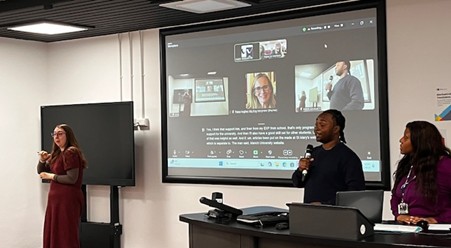
Students on the BA (Hons) British Sign Language (Interpreting) and Deaf Studies programmes at the University of Wolverhampton recently took part in two standout events designed to build confidence, employability skills, and professional competence through situated learning.
Simulated conference: A professional learning environment
The Interpreting team, Dr Thaïsa Hughes, Sandra Pratt, and Selina Jacques-King, hosted a simulated conference, offering students a lifelike professional setting to practice interpreting skills. The event featured speakers from across the West Midlands and beyond, including Zebra Access, a Deaf-led charity co-founded by University of Wolverhampton graduate, Nikki Stratton, which highlighted volunteering and career opportunities.
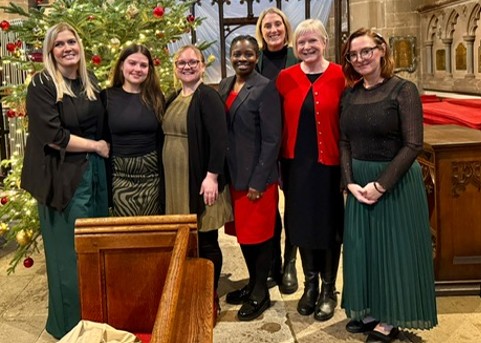
Students were particularly inspired by Jayden Payne, the first person in the UK with an Acquired Brain Injury to graduate with a BSc in Sport Rehabilitation. His presentation on Sickle Cell and Acquired Brain Injury challenged students to interpret complex medical and personal narratives into British Sign Language (BSL), reinforcing the importance of accuracy and empathy in interpreting.
Other notable contributions included:
- Louise Rhodes MBE, sharing insights from over 30 years of interpreting in education.
- Sam Dowsett, an interpreter/master’s student - presenting research on interpreting expletives in ‘To Swear or Not to Swear’.
- Lorraine Robinson, a teacher of many years’ experience, offering a historical perspective on BSL and Deaf education.
Dr Thaïsa Hughes commented: “These events create authentic learning environments where students can develop confidence and reflect on best practice. We are proud of their professionalism and growth.”
Christmas Carol service: Interpreting in a religious context
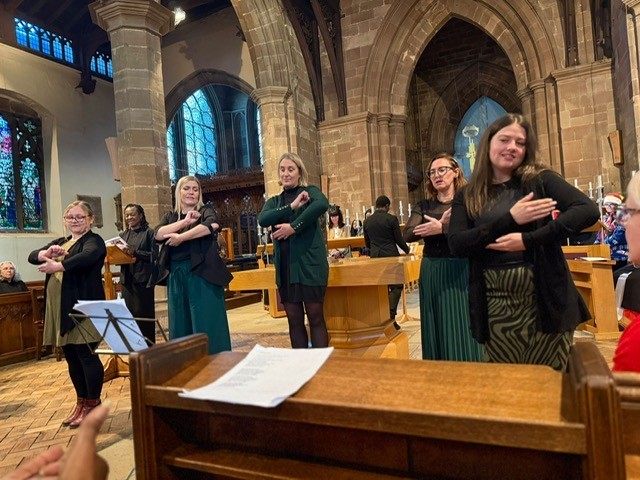
Students also participated in the University’s annual Christmas Carol Service, working alongside Sandra Pratt and Louise Rhodes MBE to interpret songs, scriptures, and sermons. Through preparation meetings and detailed debriefs, students gained invaluable experience in a high-profile setting, demonstrating teamwork and professionalism.
Sandra Pratt added: “Interpreting in a religious context is complex and requires sensitivity. Our students rose to the challenge and showed remarkable skill.”
These experiences exemplify the University’s commitment to equipping graduates with the skills and confidence needed for ethical, high-quality interpreting careers.
For more information please contact the Corporate Communications Team.