

/prod01/wlvacuk/media/departments/digital-content-and-communications/submitted-news-images/Mr-Speaker-2.jpeg)
Military Service, Football and the England 1966 World Cup Winners – Gordon Banks
14/09/2026 - 6.29
Alex Alexandrou
This is the second article in an occasional series of short articles on members of the England 1966 World Cup winning squad, that highlights aspects of their football careers and military service either in terms of National Service or serving in World War Two.
This short article will highlight snippets of Gordon Banks’ National Service as told through his own words in his autobiography published in 2002 and simply entitled: Banksy – My Autobiography, supported through additional information from a British Forces Broadcasting Service (BFBS) Forces News online article posted in 2019 entitled - British Soldiers To Perform Guard Of Honour At Gordon Banks' Funeral.
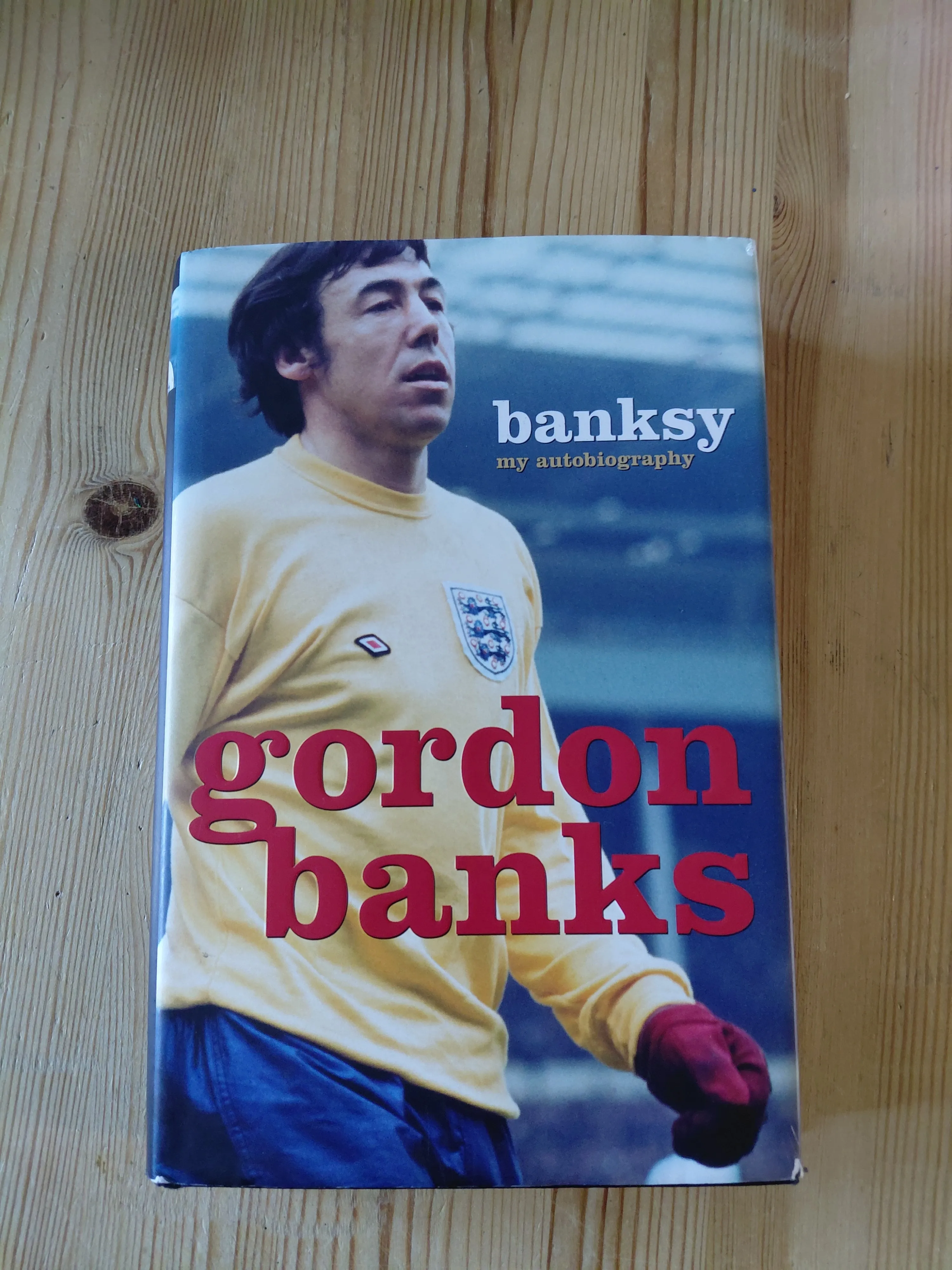
Gordon Banks Autobiography. Source: Author's Collection
It is fair to state that Gordon Banks was one of England’s finest goalkeepers of the 20th Century. Along with Alex Stepney of Manchester United and Pat Jennings of Arsenal and Spurs, he was one of my goalkeeping heroes, when I was a lad. Like many of my generation, his save from Pele in the 1970 World Cup lives long in the memory but there was much more to Gordon Banks than that one extraordinary save.
One of the interesting aspects of Gordon Banks’ career was that he did not play for one of the major or even fashionable teams. He started off at Chesterfield (1958-1959), then Leicester City (1959-1966) and culminating with Stoke City (1966-1973), where tragically his professional career in English football was cut short by a car accident that led him to eventually losing his sight in one eye. In total, he made 628 club appearances in league, domestic cup and European club competitions. During this time, he won the League Cup with both Leicester City and Stoke City. Whilst at Leicester City, he was a runner-up in the League Cup and twice on the losing side in the FA Cup Final.
He did resurrect his career in the United States in the North American Soccer League (NASL), with Fort Lauderdale Strikers, turning out for them for the 1977 and 1978 seasons. Despite, as he highlights in his autobiography, having dodgy knees, a plate in one of his elbows and no sight in one eye, he managed to adapt, to the extent that he helped them win the Eastern Division of the Atlantic Conference of the NASL in 1977, along with being voted NASL Goalkeeper of the Year.
He was awarded the English Football Writers’ Association Player of the Year in 1972, was FIFA Goalkeeper of the Year in 1966,1967, 1968, 1969, 1970 and 1971 and was awarded an OBE in 1970.
For England, he made two Under-23 appearances in 1961 against Wales and Scotland and between 1963 and 1972, he won 73 caps. He made his first appearance against Scotland in a 2-1 defeat and his final appearance was also against Scotland in a 1-0 victory. During this period, he helped England win the World Cup, the British Home Championship eight times, a Bronze Medal at the 1968 European Championships and represented England at the 1970 World Cup Finals but did not play in the Quarter-Final loss against West Germany due to food poisoning.
He signed for Chesterfield, then a Division Three North team in 1953, as a part-time youth professional, playing for the junior teams. It was whilst at Chesterfield, that Gordon Banks’ fledgling professional career was interrupted, when at the age of 17, he was called up to undertake National Service between 1955-1957. However, National Service merited just two small paragraphs in his 2002 autobiography!
We learn that he joined the Royal Signals and as he states:
“…after weeks of square-bashing at camps in Catterick and Ripon found myself posted to Germany.”
We are informed in the BFBS article that whilst in Germany, he was a Motorcycle Despatch Rider.
National Service did not curtail his footballing activities and as he describes in his autobiography:
“…While in Germany I managed to play quite a lot of football, first for my squad, then for my regimental team. We managed to win the Rhine Cup, a very prestigious trophy at the time.”
For the British Army of the Rhine (BOAR), football was significant and soldiers were encouraged to play not only in the many local cup and league competitions but also for the Army FA Challenge Cup, which is one of the most prestigious and oldest cup competitions in World Football.
However, whilst serving in Germany, it is safe to say that Gordon Banks challenged and broke the cultural norms of the time, with a brave and significant decision that proved to be a lifelong commitment. In his own words he describes this as follows:
“Fate had another wonderful stroke of luck in store for me, for it was during my time there that I met a beautiful young German girl called Ursula. I fell in love with her then and I’m even more in love with her now. Ursula and I have been married for over forty years, and have three children and five grandchildren.”
At the time, Gordon Banks was still a teenager and in my view he demonstrated courage and a great sense of maturity to enter into such a relationship. It is fair to say that emotions were still raw, as it was only a decade since the end of the Second World War and there was still animosity towards the German people.
Gordon Banks passed away in 2019, aged 81. However, the British Army accorded him one final honour. His family requested a military presence at his funeral due to his Army connections. The Royal Corps of Signals did not disappoint, as soldiers from the 16th Signal Regiment commanded by a junior officer, provided a guard of honour for his cortege on its way to Stoke Minster for his funeral.
As highlighted in the BFBS article, the then commanding officer of 16th Signal Regiment, Lieutenant Colonel Ben Davenport, stated:
“We have seen the important role that Gordon Banks has played in the life of the local community and it is fitting that we can pay our tribute by providing a guard of honour at his funeral…
… We are proud to have been asked to participate by Gordon Banks’ family…
… I am glad that our role within the local community also allows us to mark Gordon Banks’ links with the Royal Corps of Signals where he made a great impression at the start of his footballing career.”
A fitting epitaph for a great and humble footballer.
Biography
Alex Alexandrou is the Co-Founder and Chair of the Football and War Network