

Military Service, Football and the England 1966 World Cup Winners – Jimmy Armfield
25/09/2026 - 4.05
Alex Alexandrou
This is the third article in an occasional series of short articles on members of the England 1966 World Cup winning squad, that highlights aspects of their football careers and military service either in terms of National Service or serving in World War Two.
Jimmy Armfield, was a cultured right-back. He played in the 1962 World Cup tournament in Chile and although he did not play in the 1966 World Cup tournament, he was an integral and trusted member of the squad.
When I was younger, I was not really aware of Jimmy Armfield as the Blackpool and England player and later manager of Bolton Wanderers and Leeds United but the knowledgeable and thoughtful football analyst and summarizer on BBC Radio football coverage. Through researching this article, I have come to find out much more about the footballer, manager and National Serviceman.
This article will be based on three books - Fighting Back, was the first of two autobiographies written by Jimmy Armfield and published in 1963. The second autobiography entitled, Jimmy Armfield - Right Back to the Beginning, published in 2004 and the third book, Jimmy Armfield: The Official Biography, written by Roy Calley, published in 2025.
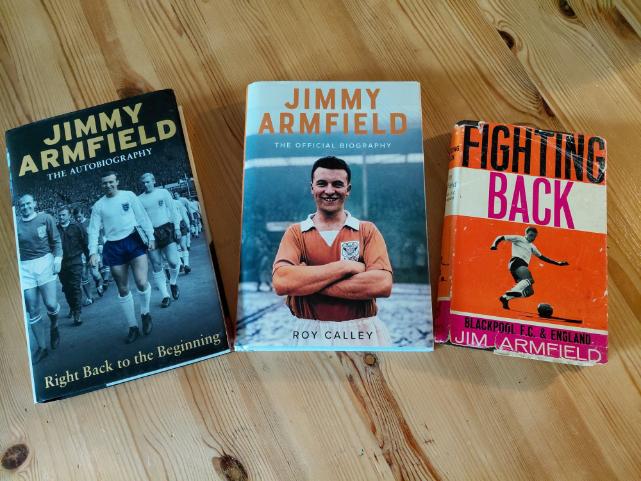
The Three Jimmy Armfield Books. Source: Author's Collection
Jimmy Armfield was born in 1935 in Manchester. During the Second World War he moved to Blackpool with his mother, whilst his father who was an Air Raid Warden, having been called up for military service and deemed not fit enough to serve, stayed behind.
Having passed his Eleven Plus, he went to Arnold Grammar School which was a rugby playing institution. Despite being a good rugby player representing his school throughout his time there and not playing competitive football outside of school, Armfield was recommended by one of his teachers to go for a trial at Blackpool and the rest they say is history!
When Jimmy Armfield was called up for National Service, he faced a conundrum, as he had a choice as whether to take an academic or football path. Having passed his A levels, he had been offered places at Loughborough College and Liverpool University, with the plan for him to study to become a teacher, after he completed his term as a National Serviceman or sign for Blackpool on professional terms. At that time, it was rare for someone of Armfield’s working class background to be the offered an opportunity to undertake higher education studies.
As he states in Fighting Back:
“I had to decide before I went into the Army. Football won, as I suppose it was always fated to win.
I signed as a part-time professional at Bloomfield Road and enlisted in The King’s Own Royal Regiment at Bowerham Barracks, Lancaster, on September 16th, 1954.
There are those who talk of their days in the Army as if there were little if anything to choose between one of H.M. barracks and the punishment block at Dartmoor. I’ll admit that I enjoyed Army life. The discipline was good for me, as I am convinced it is good for all young men. And always, for me there was…football…football.
Right Back to the Beginning, details his “introduction” to the Barracks:
“… ‘You may think you’re a footballer, Armfield but you’ll never make a soldier!’ My welcome from corporals Cathcart and Hargreaves…They were not the kind of men who specialised in helping raw recruits feel at home, and in my early days in the Army, I had to put up with their jibes. What’s more, they were wrong. I came through two years of National Service with flying colours, advancing from Private James Christopher Armfield, number 23072334 to Corporal Armfield, Physical Training Instructor.”
It should come as no surprise that Armfield settled into Army life as he had some prior knowledge and experience, as at Arnold School, he was a member of the Combined Cadet Force. Whilst his maternal grandfather had fought in the Great War and had been injured at the Somme.
However, it was not plain sailing, as he explained in Right Back to the Beginning:
“I was dumped into the long room at Bowerham - today it’s St Martin’s College – with the other 89 members of the intake, and what a place that was, a throwback to another era. I could imagine the same buildings being used in the build-up to the Boer War. Although I had not enjoyed an easy existence as I grew up, I had never experienced anything like this and it was a real shock to the system.”
It was certainly a case of getting to grips with Army life and ensuring that orders were followed, staying out of trouble and learning to forget the niceties of civilian life, as he outlined in Right Back to the Beginning:
“At the start, it was a serious case of bullshit baffles brains. We soon had a saying – if it moves, salute it; if it doesn’t, whitewash it. On the first day we were each handed a metal plate covered in gunge that had to be removed before we could put any food on it. Needless to say, we weren’t given anything to remove it with. It was the same with our black leather boots. They were covered in protective pimples, which had to be removed before the boots could be polished to the required sheen.”
He stated that no old soldier forgot his number and he guarded his rifle with is life, as there would be serious consequences for any recruit, if it was lost, stolen or damaged!
In the Official Biography of Jimmy Armfield, Roy Calley noted:
“Being in the army, though, at least gave a sense of security, and with Jimmy’s ability to self-discipline, it didn’t deem as burdensome as others may have found it. Dumped into the King’s Own Royal Regiment in Lancaster, he soon found that being part of the army was hardly a glamorous pursuit. There was the predictable boot cleaning (something he was probably more familiar with than most), parade-stomping and the general unpleasantness that could be associated with military service.”
The unpleasantness highlighted by Calley, was detailed by Armfield in Right Back to the Beginning, particularly in relation to his hair and the weight he had lost due to the food rations he was issued, as he explained:
“I didn’t have to wait long for my Army haircut. I was marched into a bare room where the local barber was waiting, electric clippers in hand. I sat down and he gave me the full treatment. In a matter of seconds, all my hair had gone, apart from one little tuft at the front. My hair has never been the same to this day.”
Calley expands on the deprivations of National Service for Armfield as follows:
“The army had to dominate his life now, especially as getting back to Blackpool from his new posting in Aldershot was not a thing of the moment…[the] lack of motorways, constant rail strikes and the demands of army life meant that he was away from home for long periods of time. It also meant he was away from the love of his life, Anne. They had begun dating some years before and it was clear the two of them were meant for each other, but army life was difficult for both of them. She would sometimes visit him, bringing sandwiches and cakes to beef up the scrawny man he had become under the harsh climate of National Service. It is testament to both that the relationship not only survived the deprivations of that but continued right up to Jimmy’s death.”
However, there were highlights and interesting predicaments to Jimmy Armfield’s National Service. The football highlights will be outlined in greater detail later. However, from a military aspect, he was getting noticed and rewarded, as he explained in Right Back to the Beginning:
“…despite the shouting and bawling from Cathcart and Hargreaves, we survived and eventually found plenty to laugh about. I’ve always been able to see the funny side of most situations and the Army was no different. What’s more, I collected the medal for the best recruit in the intake, awarded for drill, shooting, sport, cleanliness and, I suppose general attitude…
…I was soon promoted to lance corporal and that’s when my officer potential must have surfaced because I was offered a commission…I was asked if I would like to go on a course for officers but I said no.”
Interestingly, Calley in the Official Biography, highlights how single-minded Jimmy Armfield was about making it as a professional footballer and was not afraid to go against the Army’s wishes as he explains:
“Football continued to be there and when he was given the opportunity of attending an officer’s course. Jimmy firmly refused the invitation. He wanted to be a footballer and had no interest at all in continuing his career in the army once his service had been completed.”
It says much for Jimmy Armfield, that the Army identified him as one that had potential leadership capabilities and he would go on to demonstrate these both as a player and manager.
As Calley notes:
“…It was a brave and rather unpopular decision, which must have caused a few strained moments with his superiors, but the young man knew his destiny.”
He goes on to make a pertinent point about this decision as follows:
“For those who accused him in later life of being indecisive, especially as manager of Leeds United, then this was a Jimmy Armfield who knew how to make a decision and then stand by it.”
Calley goes on to state:
“For that reason, Jimmy stayed in England when the rest of the regiment were posted to Hong Kong…So, he stayed and took on the role of a PT Instructor.”
This role was not uncommon for professional footballers and had its antecedents when professional footballers were drafted for service during the Second World War.
In Right Back to the Beginning, Armfield detailed his financial situation in relation to his Army pay and once he had signed his professional contract with Blackpool. His first week’s pay in the Army was 10 shillings, whilst his football contract was a £1 a week retainer and an extra £3 if he played for the reserves and £6 extra if he played for the first team.
It is fair to state and it is well documented, not only in many of the blog articles we have published but also in the numerous Network seminar presentations, that Army Football was plentiful from the turn of the 20th Century and continued to be so, throughout the era of National Service that came to an end in 1963. Jimmy Armfield certainly benefited from the abundance of Army Football opportunities at different levels. It is fair to state, this enabled him to further develop as a footballer that benefited his civilian footballing aspirations, as he describes in Fighting Back:
“I had only been a minnow amongst whales at Bloomfield Road. In the Army I was never so conceited as to think I was one of the whales, but at least I was a bigger fish in the pond than I had been.
I played for the Regiment. Soon I was chosen for the Western Command XI. And when I had a weekend pass to play for Blackpool I was upgraded to the Reserves, which is nearer to the first team than I had ever been before.”
As Calley explains in the Official Biography:
“Football was there, though, Football was always there and very soon it became clear in the kickabout games that there was something special about Lance Corporal Armfield and so, within two weeks, he was promoted to the regimental team. This didn’t just coincide with but actually resulted in them winning the North-West District League, two years running, something they had failed to do for a very, very long time.”
Without doubt, Armfield’s National Service left an indelible mark on him from a number of perspectives, that give us a good insight into what it was like for a professional footballer to be a National Serviceman Notably, in relation to developing friendships, loyalty and helping to dispel some myths along the way.
As he explains in Fighting Back:
“In the Army they decided on my record that I should be a P.T. instructor. Who was I to dispute it? I could think of no happier lot, for I was fit when I went in and I wanted to remain fit for the days that were to come when professional football would be my profession.”
He goes on to state:
“After Oswestry and its Spartan routine and discipline, which, by the way, I never resented, came the Army School of Physical Training at Aldershot. It was there that I met for the first time – and with whom I’ve been friends ever since - Bobby Cox, the captain of Dundee…
…There was Micky Lill, too, who was destined to be one of the Wolves smash-and-grab raiders. Often, when I had a short weekend pass and was too far away from Blackpool to go home to the seaside, he would invite me to his home at Welling in Kent.”
Thus strong lifelong friendships were made and this was a common occurrence with many National Servicemen, irrespective of their background.
One of the myths that Jimmy Armfield dispelled in Fighting Back, was that professional footballers had it easy during National Service, as he explains:
“Some people think – and still say – that we were the pampered darlings of the Services, the peacetime soldiers who had come out of professional football. You can forget that one. We had our privileges, but we were never spoiled.
When we were told every Saturday morning, ‘Get down to the gymnasium and clean it up!’ we were down there on our hands and knees like the rawest recruits scrubbing the floors.”
Staying in England, afforded Armfield he opportunity to continue his Blackpool career progressing through the reserve team and making his debut away at Portsmouth on the 27 December 1954. As Calley surmises:
“One can only imagine what was going through his mind at that time. At the tender age of 19, he had already served a portion of his National Service and was making a good impression in the Blackpool reserve side, as well as numerous army teams, but this was the big one.”
However, it was not a result to remember as the home team ran out 3-0 winners and after a tiring and multi-faceted journey back up north, Calley adds insult to injury, as he notes that the next day, Armfield had to:
“…get a train to Lancaster to be back in his army barracks by teatime. On his return, his footballing moment of history was effectively ignored by his disinterested officers. Such was the life of a footballer in 1954.”
Calley goes on to describe how difficult it was for Armfield (as it was for many professional footballers undertaking National Service) in balancing his Army duties whilst playing football as follows:
“He carried on his training and eventually became a full-time PTI, putting new recruits through their paces, his life now a daily routine of 5am alarm calls, breakfast and being on parade two hours later. It was exhausting but it made more of the man that Jimmy became than if he’d never experienced such a life. Thankfully, by the time the new football season had arrived in August 1955, Jimmy had left Aldershot and was now able to play for the reserve team at Blackpool. It was an incredible schedule, one which almost defies belief today. On Thursdays, he would get a call from the club to see if he was available at the weekend (something which surely must prove how valuable he had become to Blackpool FC) and then, depending on where he was stationed, either Aldershot or later back in Lancaster, he would make his plans to return for a home game – or, if it was away, then make major plans to attend. There is a story he told of regularly being on guard duty through a Friday evening until 8am, picking up his boots, catching a bus to Blackpool, lying down for a rest for an hour and then playing a full 90-minute game. Then, of course, there was the return journey afterwards. This was the love of football that this man had.”
Like many professional players undertaking National Service, they were very much in demand as Calley recounts:
“Whilst turning out for Blackpool, Jimmy was also playing for numerous army teams all over the country. He would sometimes play three games a week, which doesn’t seem too taxing – until you remember the travelling arrangements that came along with the schedule. There were numerous moments when he even had to hitch a ride back to Lancaster because he’d either missed the last bus or train or didn’t have the money!”
This was particularly the case from 1955 onwards, by which time, Armfield had become a regular in Blackpool’s first team. As he recounted in Right Back to the Beginning:
“…I became a first-team regular even though I was still in the Army. I travelled home and back at weekends and the club would call on Thursday or Friday to make sure I was available. It was a wonderful time. Players today talk about having to take part in too many matches – they should try my schedule in the Army. I thought nothing of playing for Blackpool on Saturday, for the Regiment or Western Command on Tuesday and the Army on Thursday. In between, I would be running all over the place, refereeing matches at the camp. Too much football? I couldn’t get enough – and I didn’t need to train.”
His superiors in the Regiment took an interest in his various representative matches and it was not uncommon for his Quartermaster, Company Sergeant Major and up to three Majors to watch him play! As he states in Right Back to the Beginning, “…because it was a feather in the regiment’s cap to have a player in the British Army team. I think I was the first.”
As he went on to explain:
“…We played against all sorts of sides including Northern Ireland – yes the full team – at Preston, beating them 4-3. We also played the Scottish League XI and top professional sides, including Rangers and Everton.”
During the National Service era, it is safe to say that the British Army representative side was one of the strongest teams nationally, as Armfield highlighted in Fighting Back:
“I think back nowadays on the men I played with in the Army team. They would give most present-day teams a match and beat them. There was Alan Hodgkinson of Sheffield United in goal. There was Bill Foulkes of Manchester United. And Graham Shaw of Sheffield United. There were Duncan Edwards, who was promising in those days to be the greatest wing-half of modern times, and little Eddie Coleman. None of us even dreamed that the shadow of an early death was over both of them, that the day was to come when we should never hear the word ‘Munich’ without thinking of them.
Maurice Setters, of West Bromwich Albion and Manchester United fame, was in the team which was captained by Stan Anderson, the Sunderland wing-half who was a born captain if there was ever one. There was Trevor Smith, the Birmingham centre-half, Dave Dunmore, who these days is leading the Leyton Orient forwards, and a dozen others whose names have become familiar on Football League match programmes or were already familiar to then.
One of our greatest triumphs was at Deepdale, the Preston North End ground which is almost on Blackpool’s doorstep. That was one game in which I wanted the team to make a big show. They managed it. We met the full strength of Ireland and at one time we were losing 2-0. I finished on the right wing, hobbled there all the second half with a pulled muscle. But we still won 4-3.”
One of the most prestigious British military football tournaments is the inter-services tournament, now known as the Constantinople Cup, which is competed for by the Army, Royal Navy and Royal Air Force. The first match was in 1905 between the Army and the Royal Navy, obviously before the creation of the RAF. It was expanded to include the RAF in 1921 and for the first time in 1924 was played for the Constantinople Cup.
Jimmy Armfield competed in this tournament and it had an impact on him as he describes in Fighting Back:
“We became Inter-Services Champions. We beat the Royal Navy 6-0 at Bristol and the R.A.F. 2-1. All the time I was learning. I could do nothing else but learn in such company. It was just about the best apprenticeship I could have had – and I was being paid for it – not such a lot, but still being paid. All things were just about as bright and beautiful as they could be…
I was in the British Army team and for the first time was capped for the Under-23’s against Denmark in Copenhagen.”.
The pinnacle for a British Army player was (and is) to participate in the Kentish Cup, which is the oldest ongoing cup competition in Europe. The Kentish Cup was (and still is) a triangular tournament, that when it was first instigated in the 1920-21 season, was played for by the British, Belgium and French Army teams. Jimmy Armfield had the privilege of participating in this competition but unlike his other successes in Army representative football, this playing experience was not so kind, as he explained in Right Back to the Beginning, the British Army team had:
“…earned the dubious distinction of failing to record a single win – despite having so many talented players in the side. In fairness, France had a few decent players too, fielding six B internationals and three men who would go on to win full caps, including Rene Bilard and the great Just Fontaine, one of the stars of the1958 World Cup in Sweden. So perhaps our 2-1 defeat by the French at Dulwich Hamlet’s ground wasn’t such a bad result.”
There were morale-boosting football trips abroad, as he outlined in Right Back to the Beginning:
“There was also a tour to Germany where we entertained the troops with games against Werder Bremen, Munster and Hanover, and we played Eintracht Frankfurt on the night they switched on their floodlights.”
As highlighted above, his Army representative teammates included both Eddie Coleman and Duncan Edwards of Manchester United, who just a few years later would perish in the Munich Air Disaster. Jimmy Armfield would become friends with both of them and he had an anecdote about Duncan Edwards, which he recounted in Right Back to the Beginning:
“…One of my most vivid memories of Big Dunc is from our Army days. He was in the Royal Army Ordnance Corps, stationed at Nescliffe near Shrewsbury, where the Western Command team were to assemble for a match. I travelled down by train and when I arrived, Dunc was the only other player there. He said, ‘I’ve got a ball here, let’s go out and have a kick-around.’ It was a dry day and we decided to wear our pumps rather than boots but as I was fastening mine, the lace broke. Duncan said he would go out on his own until I found another lace, which wasn’t easy in the Army. In fact, in the end, I had to improvise with a piece of string.
Halfway through my search for a substitute lace, I happened to look out of the army hut where we were based and saw Duncan out on the pitch. He was playing with the ball on his own and until that moment I never realised how skilful he was. He could do all the tricks – bouncing it on the floor with the sole of his foot, catching it on the back of his neck, backheeling it over his head, running across the field with the ball balanced on his head, flicking it from shoulder to shoulder. I stood and watched him, transfixed.”
In the Official Biography, Calley, highlights how the Army taught Jimmy “…the comradeship and loyalty that so defined his personality for the rest of his life. Loyalty, in particular, is a word that sums up Jimmy Armfield.”
In September 1956, Armfield’s National Service came to an end and in Fighting Back, Armfield stated:
“The recruiting posters used to say, ‘JOIN THE NAVY AND SEE THE WORLD.’
I joined the Army and still saw considerable areas of the civilised globe…”
Whilst, in Right Back in the Beginning, he summarised his National Service as follows:
“So I handed in all my gear and walked away from Army life. I was pleased to be out, of course, but as I walked down the hill to catch the train home from Lancaster, I had one last look back at the old place. On balance, I decided the Army had been good for me. It taught me discipline and self-sufficiency, humility and respect, and I emerged from the experience a better person. It was the first time I had been away from home and I learned to stand on my own two feet. It introduced me to another world and to people I would almost certainly never had met without National Service. In fact, the Army turned around my life. I went in as a potential university student and left as a member of a Blackpool team with realistic championship ambitions, and with an England Under-23 call up to my name.”
However, although he was demobbed, there was a potential black cloud on the horizon due to the Suez Crisis, which meant he could be recalled. Thankfully, for him, it did not come to pass and his footballing career could continue uninterrupted by outside influences.
Jimmy Armfield was one of those rare players who was a one-club man. Between 1954 and 1971, he made 568 league appearances, 33 FA Cup appearances and 25 League Cup appearances, scoring six goals. He went on to manage Bolton Wanderers between 1971 and 1974, leading them to the then Division Three Championship in the 1972-73 season. He then went on to manage Leeds United between 1974 to 1978, leading them to the 1976 European Cup Final against Bayern Munch, which they controversially lost 2-0.
For England, between 1956-1959, he was awarded 6 Under-23 caps and 3 England B caps. He went on to become a full England international making his debut in 1959 against Brazil in the famous Maracana during England’s end of season South American tour.
In 1961, due to an injury to the then captain Johnny Haynes, Walter Winterbottom handed the captaincy on a one-off basis to Armfield, who led England to a 4-1 victory over Luxembourg in a European Nations (now known as the European Championships) Cup qualifier at Highbury. During 1962 and into 1963, at the end of Walter Winterbottom’s term as England manager and into the early part of (Sir) Alf Ramsey’s tenure, not only was he regarded as the first choice right-back but was made captain, with his second outing as captain against France in a Euros qualifier. He got on well with Ramsey, who respected him. In total he captained his country 15 times, as well as playing at the 1962 World Cup Finals in Chile.
An injury in the final match of the 1963-64 season, saw him side-lined for a number of months. This proved significant, as on his return to the Blackpool team, he could not force his way back into the England set-up, losing his position to George Cohen and the captaincy to Bobby Moore.
However, his tenacious spirit, determination and singlemindedness, which were all sharpened and honed during his National Service, ensured he never gave up on getting back into the England squad. In May 1966, he was back in the England team for a friendly against Yugoslavia and he made the final squad for the1966 World Cup Finals.
Prior to the commencement of the tournament, there was a four-match tour of Scandinavia and Poland. He was selected for the first match of the tour against Finland, for which he was made captain in the absence of Bobby Moore, with England winning 3-0.
It was a bittersweet victory for Armfield, as he had one of his little toes broken, which meant he lost his place for the other three tour matches to George Cohen. Despite the injury, he was still part of the squad for the tournament but was not selected for any of the matches.
The Finland match would prove to be his 43rd and last appearance for England. He did not receive a winner’s medal at the time (as was the custom for squad members), but did receive one much later, when the rules were changed and all squad members were presented with a winner’s medal in 2009.
Although, Jimmy Armfield’s footballing career was bereft of honours, his achievements and work were recognised and honoured. He received the Freedom of Blackpool; had a statute erected outside Blackpool’s stadium and had a stand named after him; was awarded both an OBE and CBE; and inducted into the National Football Museum’s Hall of Fame.
Following a long fight against cancer, Jimmy Armfield sadly passed away in 2018.
Biography
Alex Alexandrou is the Co-Founder and Chair of the Football and War Network